The history of the Toyota logo and its three ellipses
From the 1936 competition to the three-ellipse emblem launched in 1989, here is how the Toyota logo became one of the most recognizable automotive symbols in the world.
The history of the Toyota logo and its three ellipses
Reading time: about 9 minutes.
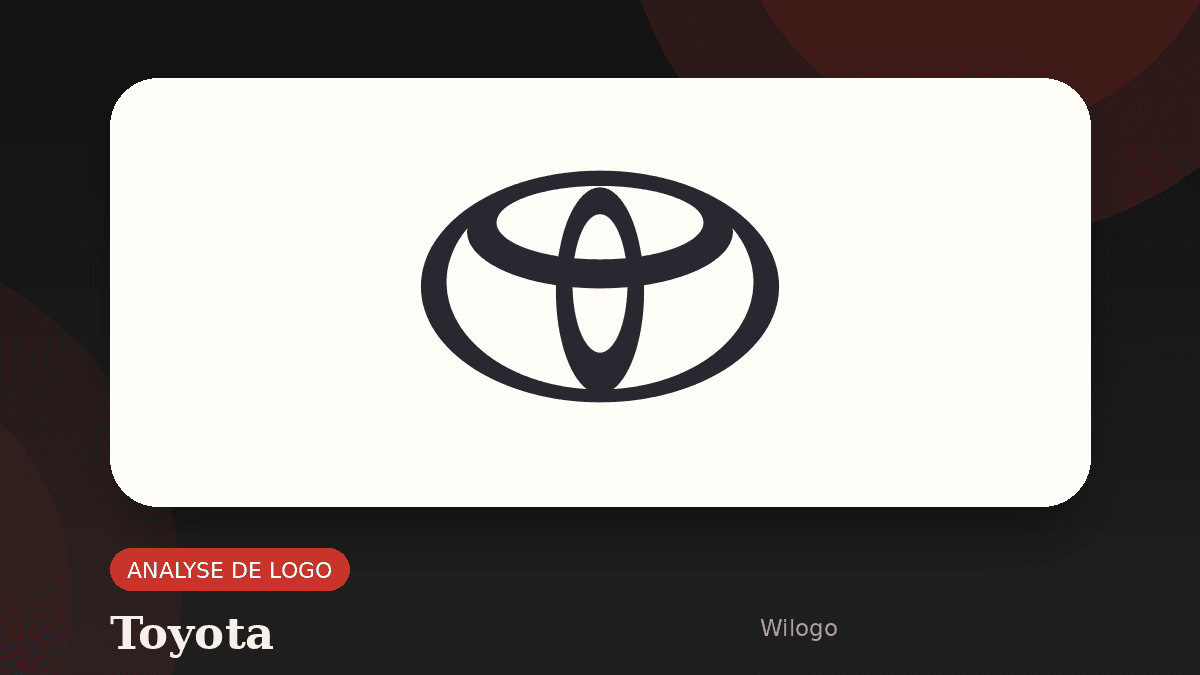
Real Toyota logo source
To avoid an invented or approximate visual, this article now uses the real logo artwork from the source below.

Source: Wikimedia Commons
The Toyota logo is one of those symbols you can recognize instantly even without reading the brand name. Yet behind those three simple ellipses lies a much richer story involving a family name, Japanese writing, global expansion, and a design system built to last.
Toyota’s official materials make it clear that the current emblem was not a casual redesign. It was developed over about five years before being introduced in October 1989 for the company’s fiftieth anniversary. That alone tells you something important: when a global company updates its main symbol, it is solving a strategic problem, not just chasing novelty.
In this article, we trace the shift from Toyoda to Toyota, review the early emblems, explain the meaning of the three ellipses, and pull out practical branding lessons for smaller businesses. If you enjoy this kind of brand analysis, you can also browse our article on the Peugeot logo, our breakdown of the Amazon logo, or our piece on the Chanel logo.
Why the Toyota logo still feels strong in 2026
Many automotive logos try to signal power, speed, prestige, or aggression. Toyota takes a more restrained route. Its emblem is geometric, controlled, and highly legible. That restraint is part of its strength: it works on a hood, on a steering wheel, on a mobile screen, on signage, and in monochrome without losing recognition.
This matters because global brands need symbols that travel well. A logo that depends too heavily on language, decoration, or a short-lived trend usually weakens as it expands across markets. Toyota’s emblem stays useful because it can function without text and because it avoids stylistic details that would age quickly.
The broader branding lesson is simple: a logo does not have to tell the entire story on its own. It needs to create a stable visual anchor that the rest of the brand experience can reinforce over time.
From Toyoda to Toyota: where the name came from
Toyota’s roots lie in the Toyoda family and in the industrial history of automatic looms developed by Sakichi Toyoda. The automotive branch then grew under Kiichiro Toyoda, and the company’s first passenger car arrived in the 1930s.
According to Toyota and widely cited historical references, a public logo contest was held in 1936. At that time, the company still used the Toyoda name. It later adopted Toyota instead. The reasons usually given are practical and symbolic at the same time: Toyota sounded cleaner, looked simpler, and could be written in eight brush strokes in katakana, a number associated with good fortune and prosperity in Japan.
This change is a useful reminder that branding is not always about preserving a name in its original form. Sometimes the strongest move is to refine the name so that it becomes clearer, more memorable, and more scalable internationally.
The early emblems before the ellipses
Before the modern emblem, Toyota used marks that were much closer to its local and historical context. Toyota’s own brand pages show the original 1936 Toyoda mark and the decorative front emblems used on the first passenger cars from 1937 onward. These included Japanese characters and forms that made sense in their time and place.
But what works for an emerging industrial company inside one national market does not always work for a mass-market global brand. Early logos often express origin; mature logos must express ambition. That is exactly the shift Toyota had to manage as it grew.
You can see a similar pattern across many famous brands. At the beginning, identity is about being seen at all. Later, it becomes about creating a system that remains consistent across products, media, and generations.
1989: the turning point
In October 1989, Toyota officially announced a new brand mark for Toyota vehicles, with global rollout beginning in early 1990. This was not a cosmetic refresh. It was an explicit move to strengthen the Toyota brand image worldwide.
Toyota also notes that the development took about five years. That long timeframe makes sense when you remember how many jobs a car emblem has to perform. It must work in metal, in print, in retail environments, on technical documents, in broadcast ads, and in the growing digital ecosystem that would come later.
The timing also mattered. By the late 1980s, Toyota was no longer just a strong Japanese manufacturer. It was a global automotive player that needed a symbol matching its scale, reliability, and technological ambition without becoming overly ornate or theatrical.
What the three ellipses actually mean
Toyota has provided its own official explanation. The two inner ellipses represent the heart of the customer and the heart of the product. Their overlap signals mutual trust and benefit. Together, they also create a stylized T for Toyota and can be read as a steering wheel.
The outer ellipse represents the world embracing Toyota. Toyota also describes the surrounding negative space as a sign of the infinite expansion of the brand’s values, such as quality, innovation, and the future of mobility.
- Two inner ellipses: the customer’s heart and the product’s heart.
- Overlap: trust, mutual benefit, and a hidden T shape.
- Overall reading: a steering wheel can also be perceived.
- Outer ellipse: the world surrounding the brand.
- Negative space: room for continuous growth and future possibilities.
This is a good example of symbolism done well. The emblem carries a richer explanation if you want one, yet it remains visually functional even if you never hear that explanation.
Why the design works so well
First, it is memorable. The three-ellipse silhouette is easy to spot from a distance. Second, it is flexible. It works in chrome, in print, in black and white, and in small digital uses. Third, it is emotionally balanced. It does not push too far into luxury, sportiness, or utility. That makes it compatible with a broad product range and a broad audience.
Another important point is that the emblem is abstract but not random. The symmetry, spacing, and implied letterform create structure without making the mark feel lifeless. That balance between engineering and symbolism is especially useful for industrial brands.
Finally, Toyota has benefited from stability. The emblem has not needed constant reinvention. In branding, that is a major advantage. Recognition compounds over time when a company resists unnecessary redesign cycles.
Branding lessons smaller companies can apply
Even if your business has nothing to do with cars, Toyota’s logo history offers practical lessons. Simplifying a name or symbol can be strategic, not reductive. A mark should be judged by how well it survives real-world use, not by how clever it sounds in a presentation. And symbolism works best when it supports clarity rather than replacing it.
- Choose clarity over historical literalism when the brand needs scale.
- Design for actual use cases: signage, small screens, print, monochrome, packaging, and motion.
- Let the story enrich the symbol, but do not make the symbol depend on the story.
- Consistency over decades can be more valuable than frequent rebrands.
If you want to create a logo with that kind of long-term thinking, the best starting point is a precise brief about your audience, your positioning, your tone, and your usage constraints. You can start that process here: create your logo brief on Wilogo.
FAQ
What do the three ellipses in the Toyota logo represent?
Officially, the two inner ellipses represent the heart of the customer and the heart of the product, while the outer ellipse represents the world around Toyota.
When did Toyota adopt the current logo?
Toyota announced the new brand mark in October 1989 and began rolling it out globally in early 1990.
Why did Toyoda become Toyota?
The switch is usually explained by pronunciation, visual simplicity, and the fact that Toyota can be written in eight brush strokes in katakana, a lucky number in Japanese culture.
Does the Toyota logo represent a steering wheel?
Yes. Toyota’s own explanation allows that reading: the overlapping ellipses can be seen as a stylized T and also suggest a steering wheel.
Conclusion
The Toyota logo is a strong example of industrial design becoming a universal brand symbol. It does not impress through noise or complexity. It impresses because it holds up across time, scale, and media.
If you want your own brand identity to age well, the lesson is not to imitate Toyota’s shape. It is to emulate Toyota’s discipline: clarity, durability, and strategic intent. To begin with a proper foundation, you can fill out your logo brief on Wilogo.