Mercedes-Benz logo history: the story behind the three-pointed star
From 1909 to today, the Mercedes-Benz logo tells the story of an industrial ambition that became a global symbol. Here is what the three-pointed star really means.
Mercedes-Benz logo history: the story behind the three-pointed star
Reading time: about 9 minutes.
Real Mercedes-Benz logo source
To avoid an invented or approximate visual, this article now uses the real logo artwork from the source below.

Source: Wikimedia Commons
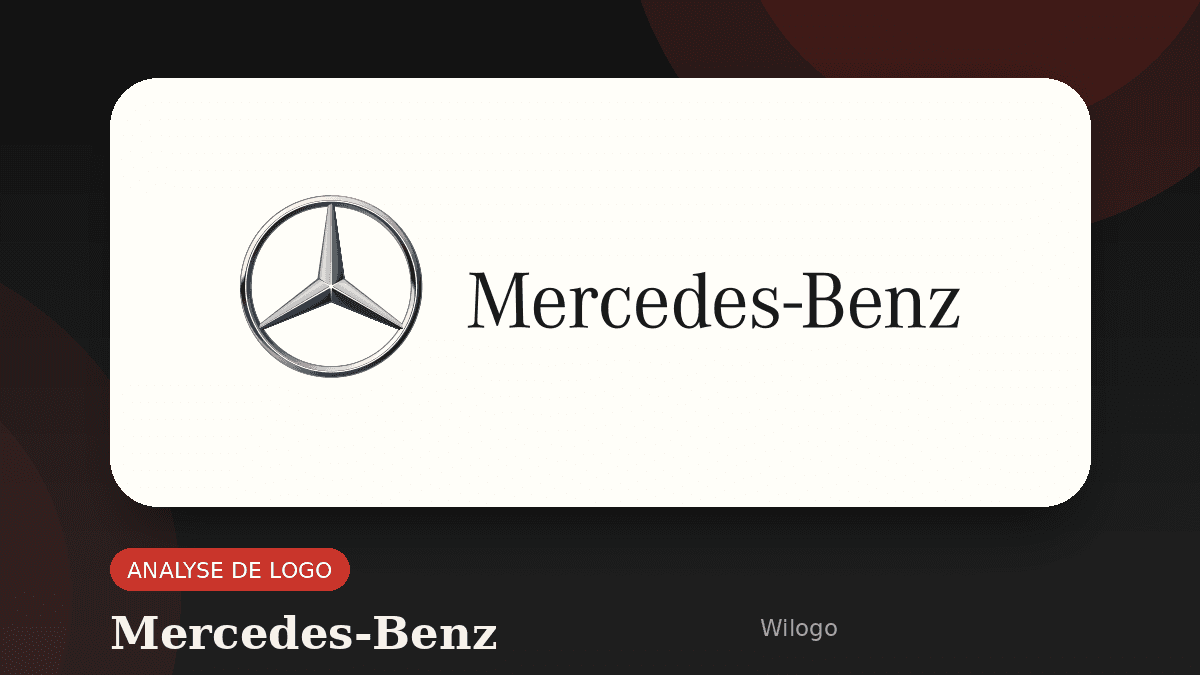
The Mercedes-Benz logo is one of those symbols people recognize instantly, even from far away or at a tiny size. A three-pointed star, a circle, sometimes a wreath in older versions, and a presence that suggests engineering, prestige, and longevity all at once. Yet behind that apparent simplicity lies a richer story than a hood ornament.
The Mercedes star was not born as decoration. It appeared before Mercedes-Benz itself officially existed, at a time when Daimler and Benz were still separate companies. Over the decades, the sign would accompany a major industrial merger, adapt to changing automotive design, move from ornament to global signature, and become one of the most stable visual codes in the car industry.
In this article, we look at the main stages of that evolution, unpack what the three-pointed star actually means, and explain why the logo still feels like a benchmark in 2026. If you enjoy logo stories from the automotive world, you can also read our pieces on the Ferrari logo, the Toyota logo, or our analysis of the Google logo evolution to compare very different branding strategies.
Why the Mercedes-Benz logo remains so strong
Many automotive logos try to impress through speed, power, or aggression. Mercedes-Benz takes a quieter route. Its emblem is not an animal, not a loaded coat of arms, and not a complicated wordmark. It is built on simple geometry that is easy to remember and naturally suggests technical control.
That restraint is exactly why it is powerful. A star inside a circle can live on a grille, steering wheel, website, mobile app, dealership façade, or corporate document without losing its identity. The symbol survives chrome, black-and-white treatments, embossed finishes, and flat digital design. Very few car brands can claim that level of continuity.
In 2026, that consistency matters even more. Many brands are simplifying their visual identities for screens, while Mercedes seems to have anticipated that logic long ago. Its symbol stays legible without text, premium without being noisy, and modern without chasing novelty. That is what durable logo design looks like.
1909: where the star comes from
The history of the Mercedes-Benz logo begins before Mercedes-Benz itself. Historical summaries relayed by Wikipedia and Motor Authority note that in June 1909, Daimler-Motoren-Gesellschaft registered both a three-pointed star and a four-pointed star. Only the three-pointed version would actually be used.
Why a star? The best-known story goes back to Gottlieb Daimler. His sons Paul and Adolf are said to have reused a symbol their father had once used to mark the family home on a postcard. Over time, that star came to represent something larger than a personal sign: Daimler's ambition to motorize transport on land, on water, and in the air.
That origin matters because it gives the logo real symbolic depth. The star does not simply point to a product category. It reflects a broader industrial vision. From the very beginning, the sign carried the idea of reach, mobility, and technical ambition.
Why the Benz wreath mattered
At the same time, Benz & Cie. was building its own visual identity. According to Motor Authority, the company used a logo featuring the word Benz inside a laurel wreath, a clear reference to racing success and early prestige. This is a crucial detail because the future Mercedes-Benz logo would emerge from the meeting of these two histories.
The wreath adds a different tone from Daimler's star. The star suggests technological ambition and broad industrial purpose. The laurel speaks more directly to victory, distinction, and earned reputation. When the two elements finally came together, the result was more than a merger graphic: it was a union of narratives.
From a branding perspective, this is especially interesting. When companies merge, they often struggle to create a shared identity without erasing one side of the story. Mercedes-Benz solved that problem by composing a new emblem from meaningful existing elements instead of starting from a blank page.
1925-1926: the merger that created the modern symbol
The decisive shift came in the mid-1920s. A snippet visible in official Mercedes-Benz Group search results explains that on February 18, 1925, the two companies registered a shared logo that combined Daimler's Mercedes star with Benz's laurel wreath. The following year, the industrial merger created Daimler-Benz AG, and the symbol appeared on road cars.
What we now think of as the Mercedes-Benz logo was therefore built through combination rather than pure invention. The star stayed at the center, the circle framed it, and the Benz heritage completed the mark. That move solved several branding challenges at once. The new company needed continuity, recognizability, and enough authority to carry a major industrial identity. The symbol delivered all three without becoming cluttered.
The brilliance of the composition is that it remains readable even if you do not know the merger story. You still see a balanced, institutional, premium mark. And once you learn the historical context, the logo gains another layer of meaning without becoming visually heavier.
How the logo evolved without losing itself
Like every major emblem, the Mercedes-Benz logo changed in finish and presentation over time. Older versions displayed more typography, more decorative detail, and more visible references to the wreath. Over the years, the brand stripped the system back to its strongest core: the three-pointed star inside a circle.
Motor Authority also points out that the emblem long lived as a hood ornament before becoming more central in the grille. That change was not just cosmetic. It followed the realities of aerodynamics, vehicle design, and visibility across different car lines. In other words, the core symbol stayed stable while the way it was displayed adapted to changing contexts.
The contemporary version pushes that logic even further. On screens, in app icons, in vehicle interfaces, or on corporate assets, Mercedes can use an even more reduced version without sacrificing recognition. That is a sign of brand maturity: the identity no longer depends on decorative excess to be noticed.
What the three-pointed star really means
The most widely accepted explanation is straightforward: the three branches represent mobility on land, sea, and air. That interpretation appears both in historical summaries and in automotive media retellings. It captures Daimler's original vision well: not to think only in terms of cars, but in terms of motorization as a broader technological frontier.
This symbolism works precisely because it stays open. Most people do not need to know the story to recognize the logo. But for those who do, the narrative adds depth. The mark was not chosen randomly. It is a simple symbol carrying an unusually large ambition.
- Three branches: land, water, and air.
- The circle: unity, stability, and visual coherence.
- The wreath in earlier versions: prestige, victory, and Benz heritage.
- The whole symbol: technical confidence with premium restraint.
What makes the Mercedes-Benz logo so effective is that it sits between literal storytelling and total abstraction. It is concrete enough to remember, yet abstract enough to work across time, languages, and media.
Why the logo still works so well
First, memorability. A three-pointed star inside a circle creates a silhouette that the eye retains quickly. Second, reproducibility. The symbol works in metal, embossing, monochrome, motion graphics, and flat interface design. Third, tone. Mercedes communicates premium value through discipline rather than visual overstatement.
Another major strength is autonomy. The mark does not need the full brand name to work. That matters in a world of mixed touchpoints: social media, mobile apps, dashboards, B2B documents, signage, merchandise, and parts. A great symbol should survive on its own, and the Mercedes star clearly does.
Finally, long-term consistency builds trust. When a company keeps the same visual core for decades, it accumulates recognition. At some point, the logo stops being just a brand asset and becomes a cultural reference point. That is exactly what happened here.
Branding lessons worth keeping
Even if your company has nothing to do with luxury cars, the history of the Mercedes-Benz logo offers several useful lessons. A strong logo does not need to explain everything. It needs to create a stable anchor. A simple shape can carry a rich story if the brand knows how to articulate it. And visual continuity usually creates more value than constant reinvention.
- Simple signs survive changes in format better.
- Good symbolism adds meaning without making a logo harder to use.
- Strong identities can emerge from combining histories instead of erasing them.
- Consistency over time often creates more value than frequent rebrands.
If you want a durable identity for your own business, the most useful place to start is a clear brief: what you do, who you serve, what tone you want, and where the logo must actually live. You can fill out your logo brief on Wilogo to turn that thinking into a concrete creative starting point.
FAQ
What does the Mercedes-Benz three-pointed star represent?
It traditionally represents Daimler's ambition to motorize transportation on land, on water, and in the air.
When did the Mercedes-Benz logo appear?
The Daimler star was registered in 1909, while the combined Mercedes-Benz logo took shape around the 1925-1926 merger with Benz.
Why did older versions include a wreath?
The wreath came from Benz & Cie. and referenced racing success as well as the company's earlier visual identity.
Why has the Mercedes-Benz logo changed so little?
Because its basic structure is already strong: simple, distinctive, legible, and adaptable to almost every medium.
Conclusion
The Mercedes-Benz logo is a strong example of a symbol that crossed a century without losing relevance. Its history blends industrial vision, merger logic, automotive prestige, and graphic discipline. The three-pointed star is not only elegant; it is strategically clear.
For a smaller brand, the goal is not to copy Mercedes, but to apply the same standard: build a sign that is simple, durable, coherent, and able to live for years. If you want to start that work for your own brand, you can describe your project in the Wilogo brief.