The Evolution of the Google Logo: From 1998 to Today
Trace the complete history of the Google logo, from its creation by Sergey Brin in 1998 to the Product Sans redesign of 2015 and the gradient update of 2025. An analysis of each version and design choices.
Origins: Backrub, then Google
Before being called Google, the world's most used search engine had a much less glamorous name: Backrub. Created in 1995 by two Stanford students — Sergey Brin and Larry Page — this university project indexed the web by analyzing backlinks between pages. The concept was revolutionary, but the name… much less so.
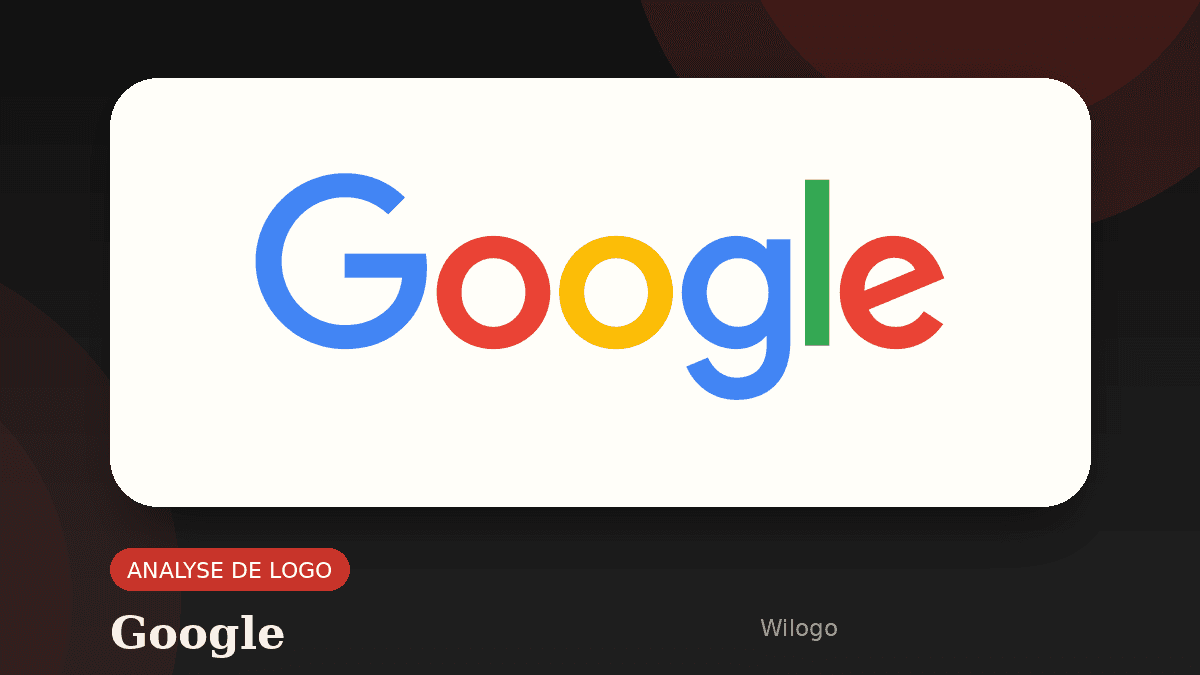
Real Google logo source
To avoid an invented or approximate visual, this article now uses the real logo artwork from the source below.

Source: Wikimedia Commons
In 1997, Backrub became Google, referencing the mathematical term “googol” (10 to the power of 100). A nod to the project's grand ambition: to organize all the world's information. The company's headquarters, the Googleplex, also takes its name from “googolplex” (10 to the power of googol), a number so large it defies human comprehension.
And with this new name, a logo was needed. This is where a fascinating visual story begins, reflecting at each stage the evolution of a startup that became one of the most powerful companies on the planet.
1997 — The very first homemade logo
The first Google logo is far from a graphic masterpiece — and that's precisely what makes it endearing. Larry Page created it himself using GIMP, a free and open-source image editing software.
The result? 3D letters in bright colors (green, red, yellow, blue) that seem to float in space. The rendering is clearly amateurish, typical of the web aesthetic of the 90s. But the foundations of Google's identity are already there: multiple colors and a certain casualness.
This logo was not meant to last. It accompanied the university research project and primarily served as a visual marker to distinguish Google from other search engines of the time (AltaVista, Lycos, Yahoo!).
1998 — Baskerville Bold and the 4 colors
In September 1998, Google got its first real professional logo. The design uses the Baskerville Bold font, an elegant and classic serif typeface. This is also when the order of colors is definitively established: blue, red, yellow, blue, green, red.
Interestingly, in this very first Baskerville version, the initial “G” was green and not blue. This detail would be corrected a few weeks later, in October 1998, when the G turned blue — the color combination we still know today.
Another peculiarity of this time: an exclamation point appeared at the end of the word “Google!”, presumably inspired by Yahoo!, then the undisputed leader of the web. This nod would disappear the following year — Google didn't need to imitate anyone.
1999 — Ruth Kedar and the Catull font
May 1999 marks a major turning point. Graphic designer Ruth Kedar is tasked with designing the official Google logo. After many iterations, she opts for the Catull font, a serif typeface created by Gustav Jaeger in 1982 for the Berthold foundry.
Why Catull? Ruth Kedar explained it this way: she was looking for a font “rooted in the tradition of beautiful typefaces of the past, but with a contemporary and surprising side.” The precise serifs and elegant shapes of Catull gave the logo a character that was both serious and accessible.
The exclamation point disappears. The colors remain the same, with drop shadows and 3D reflections that give depth to the letters. Ruth Kedar also established a key principle: primary colors dominate (blue, red, yellow), but the “L” is green — a secondary color placed there to remind that “Google does not follow the rules”.
This Catull logo would remain the foundation of Google's identity for over 16 years, until 2015. It's the version that billions of people have etched in their memory.
2010-2013 — The era of flat design
During this period, the logo evolves with subtle touches, reflecting the general trend of web design towards simplicity.
May 2010: Goodbye shadows
In May 2010, Google introduced a lighter version of its logo for the search page. Drop shadows are significantly reduced, the second “o” takes on a more orange hue, and the letters appear flatter. The Catull font remains, but the rendering is more modern.
November 2010: Harmonization
A few months later, this simplified version is deployed across all Google services (Gmail, Google Apps, etc.). The shades of blue are slightly adjusted for better consistency across the ecosystem.
September 2013: Total flat design
Google takes the plunge into flat design by removing all shadows and reflections. The logo becomes completely flat and matte. This reflects a trend affecting the entire web: Apple moves to iOS 7 with its flat design, Microsoft adopts Metro, and Google follows suit.
The adjustments are subtle but significant. In May 2014, a final micro-adjustment shifts the second “g” one pixel to the right and the “l” one pixel down and to the right. Pixel-perfect before it was a thing.
2015 — The Product Sans revolution
On September 1, 2015, Google unveiled its biggest visual overhaul since 1999. And this time, the change is radical: the serif Catull font gives way to Product Sans, a geometric sans-serif typeface created in-house by Google.
Why such a change? By 2015, Google was no longer just a search engine. It was a complete ecosystem: Android, Chrome, Gmail, Maps, YouTube, Cloud… The logo had to work across all platforms, from the largest desktop screen to the smallest smartphone, including smartwatches.
The serifs of Catull, elegant on a computer screen, became unreadable at very small sizes. Product Sans, with its simple geometric shapes and clean lines, solves this problem. The logo is readable everywhere, from the app icon to the billboard.
The colors remain the same — blue, red, yellow, blue, green, red — but the shift from serif to sans-serif gives the logo a spectacular youthful look. Google visually transitions from a late 90s company to a decidedly modern tech brand.
This overhaul comes with a new complete visual identity: a multicolored “G”, four animated dots (used for Google Assistant), and a microphone, all rendered in the same primary colors + green.
2025 — The shift to gradients
In May 2025, Google introduces a subtle yet notable evolution: on the Google app for iPhone and Pixel phones, the logo adopts gradients between color blocks instead of the solid colors used since 1998.
This is not a major overhaul, but an interesting signal. Gradients are in vogue: many tech brands (Instagram, Firefox, Microsoft) have incorporated color transitions into their visual identities in recent years. Google follows this trend while retaining its four iconic colors.
For now, this gradient version is only deployed on certain mobile platforms. The classic Product Sans logo remains in use on google.com and the majority of services. Stay tuned.
The meaning of colors
The four colors of the Google logo are not a coincidence. Since 1998, they have followed a precise scheme: blue, red, yellow, blue, green, red.
Three primary colors (blue, red, yellow) dominate the logo. But the “L” is green — a secondary color obtained by mixing blue and yellow. As Ruth Kedar explained, this break in the primary scheme symbolizes that Google does not follow conventions.
Beyond symbolism, these bright colors serve a practical function: they make the logo immediately recognizable and give it a cheerful and accessible character. In a world of corporate logos often monochrome (IBM in blue, Apple in gray, Microsoft in black), Google's multicolored palette stands out and remains memorable.
The exact shades have slightly evolved over the versions (the yellow of the second “o” turned orange in 2010, the blues were saturated in 2013), but the sequence of colors has never changed.
Google Doodles: a playful logo
One of Google's most endearing features is its tradition of Doodles: modified versions of the logo to celebrate events, anniversaries, or personalities.
The very first Doodle dates back to 1998, when Larry Page and Sergey Brin added a little stick figure behind the second “o” to signal their participation in the Burning Man festival. If the servers went down during their absence, users would understand that no one was in the office.
Since then, Doodles have become a true institution. Dennis Hwang, then an intern, was the first official “Doodler” in 2000, creating a logo for July 14 (French National Day). Today, an entire team designs hundreds of Doodles each year — some interactive, others animated, sometimes even real mini-games.
Doodles perfectly illustrate the philosophy of the Google logo: a strong identity but never static, capable of reinventing itself daily while remaining instantly recognizable.
What the evolution of the Google logo teaches us
The history of the Google logo offers several valuable lessons for anyone looking to create or evolve a visual identity:
1. A logo doesn't need to be perfect from the start
The first logo from 1997 was frankly rudimentary. And that's normal: at this stage, the important thing was the product, not the packaging. A logo can (and should) evolve with the company.
2. Consistency trumps originality
In nearly 30 years, Google has never changed its colors. The blue-red-yellow-blue-green-red sequence has remained the same since 1998. It is this consistency that makes the logo immediately identifiable, regardless of the version.
3. Adapting your logo to platforms is essential
The shift from Catull (serif) to Product Sans (sans-serif) in 2015 was not an aesthetic whim. It was a technical necessity: the logo had to be readable on screens of all sizes. If your logo doesn't work in 16×16 pixels (favicon), it has a problem. You can learn more about responsive logos in our dedicated guide.
4. Small adjustments matter
Between 1999 and 2015, the logo underwent dozens of micro-modifications: adjusted shades, reduced shadows, moved pixels. These gradual evolutions allow it to stay current without destabilizing users.
5. Identity goes beyond the logo
Since 2015, Google's identity is not limited to the wordmark. The multicolored “G”, the four animated dots, the microphone… All form a coherent visual system. This is the modern approach to branding: think in systems, not in isolated logos.
If you're thinking about creating or redesigning your own logo, these principles are an excellent starting point. You can also create your logo with Wilogo Studio and see how our AI designers interpret your brief with the same demand for consistency and readability.
FAQ
Who created the current Google logo?
The current logo (since 2015) was designed by Google's internal design team. It uses the Product Sans font, created specifically by Google. The previous version (1999-2015) was designed by graphic designer Ruth Kedar using the Catull font.
Why does the Google logo use 4 colors?
The logo uses the three primary colors (blue, red, yellow) plus green, a secondary color placed on the “L”. This choice symbolizes the idea that Google does not follow conventions. The multicolored palette also makes the logo immediately recognizable and gives it an accessible and playful character.
How many times has the Google logo changed?
The Google logo has undergone about 7 major versions between 1997 and 2025: the 3D logo of 1997, the Baskerville version of 1998, the Catull logo of 1999, the adjustments of 2010 and 2013, the Product Sans overhaul of 2015, and the gradient update of 2025. Not to mention the thousands of temporary Google Doodles.
What font does the Google logo use?
Since September 2015, the Google logo uses Product Sans, a geometric sans-serif font created in-house by Google. Before that, the logo used the Catull font (1999-2015), and briefly Baskerville Bold (1998).
What does the name Google mean?
The name “Google” is derived from “googol”, a mathematical term denoting the number 10 to the power of 100 (a 1 followed by 100 zeros). This choice reflects the founders' ambition to organize an almost infinite amount of information on the web.