The Coca-Cola Logo: 140 Years of Typographic Evolution
From accountant Frank Robinson to a global icon: a look back at the history of the Coca-Cola logo, its Spencerian script, its evolutions, and branding lessons from a typography that has remained unchanged since 1886.
A Typography Born in 1886
There are logos designed by the greatest design studios in the world. And then there is that of Coca-Cola — hand-drawn by an accountant in an Atlanta office nearly 140 years ago. Since then, this cursive typography has become one of the most recognized on the planet, identifiable by 94% of the global population according to brand estimates.
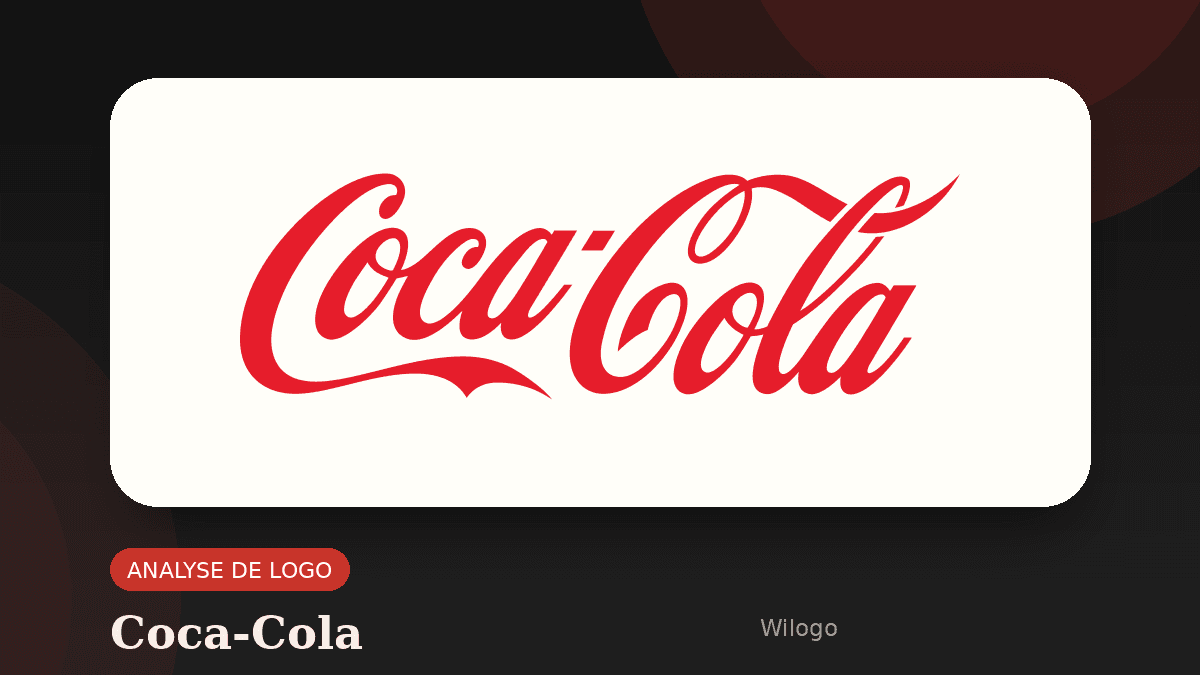
Real Coca-Cola logo source
To avoid an invented or approximate visual, this article now uses the real logo artwork from the source below.

Source: Wikimedia Commons
What makes this story fascinating is not just the longevity of the logo. It is the fact that it has practically never changed. While almost all century-old brands have profoundly altered their visual identity over the decades, Coca-Cola has traversed the 20th and 21st centuries with the same cursive writing, the same curves, the same fluidity.
How did a simple handwritten lettering become a universal symbol? A look back at an extraordinary branding story.
The Origins: Pemberton, Robinson, and Spencerian Script
In 1886, pharmacist John Stith Pemberton developed a new drink made from coca leaves and kola nuts in his laboratory in Atlanta, Georgia. He was looking for a catchy trade name. It was his partner and accountant, Frank Mason Robinson, who would provide him with much more than a name.
Robinson was a methodical man with a keen sense of business. When Pemberton asked for his advice, he suggested “Coca-Cola”, believing that “the two Cs would look good in advertising”. The alliteration is effective, the rhythm is fluid, the name is memorable. But Robinson did not stop there.
He knew that in late 19th century America, the appearance of a name mattered as much as its sound. Business correspondence was still handwritten, and the style of writing said something about the quality of a product. Robinson therefore decided to write the brand name by hand, in the most elegant calligraphic style of the time: Spencerian script.
The Birth of the Logo: “The Two Cs Would Look Good in Advertising”
Robinson experimented with several versions of the lettering. He traced the words “Coca-Cola” in Spencerian, adjusted the loops, played with the thick and thin strokes. He presented his work to the other members of Pemberton's young company, who unanimously adopted the writing.
What is striking about this process is its total lack of formality. No call for proposals, no advertising agency, no focus group. An accountant who mastered the calligraphy of his time, a pen, ink — and remarkable business intuition.
The result is a fluid signature, with generous curves, featuring those two large ornamental Cs that give the logo its distinctive character. The letters flow naturally, as if someone had signed an important document. This is exactly the desired effect: to give this new drink an air of respectability and authenticity.
The first advertisement for Coca-Cola appeared on May 29, 1886 in the The Atlanta Journal, already featuring this characteristic lettering. The logo accompanied a simple promise: “Delicious and Refreshing”.
Spencerian Script: A Forgotten Art Becomes an Icon
To understand why the Coca-Cola logo has such a particular shape, one must delve into the history of American calligraphy.
Spencerian script is a calligraphy system developed by Platt Rogers Spencer in the 1840s. It was the standard writing style in the United States during the second half of the 19th century — used in schools, business correspondence, and accounting. Spencer himself was inspired by the curves of nature: pebbles polished by rivers, waves, plant shapes.
Characteristics of Spencerian Script:
- Fine and delicate strokes, with a rightward slant of about 52 degrees
- Marked alternation between thick (descending thick strokes) and thin (ascending thin strokes)
- Ornamental loops on capital letters
- Fluidity and continuity between letters
By the early 20th century, Spencerian was gradually replaced by simpler and faster scripts, adapted to the world of typewriters. Today, it is a style almost disappeared from common use — except in one very visible place: the Coca-Cola logo.
This gives the logo its timeless dimension. It does not fit into any modern graphic trend because it comes from before modern graphic trends. It is, in a way, outside of time.
The Evolution of the Logo from 1886 to Today
Contrary to what one might think, the Coca-Cola logo has not been completely frozen for 140 years. It has undergone subtle adjustments — but never a radical redesign. Here are the key stages.
1886-1890: The First Versions
The very first uses of the logo show a Spencerian calligraphy quite faithful to Robinson's original tracing. The words “Trade Mark” appear in the tail of the first C of “Coca.” Proportions vary slightly depending on the media (advertisements, signs, labels), as everything is still reproduced by hand.
1890-1891: The Attempted Change
This is the only period when the logo significantly deviates from the original. Under the influence of Asa Candler, who bought the formula and the company from Pemberton, a more ornate and “playful” version is attempted. The letters are more spaced out, with additional flourishes.
The experiment does not last. Candler quickly understands that the original lettering has already gained public recognition. In 1893, he officially registers the logo in its original version as a trademark. This is a visionary decision: barely seven years after the brand's creation, the design is already protected.
1903-1941: Stabilization
The typography stabilizes with the mention “Trade Mark Registered” inscribed in the tail of the C. It is during this period that Coca-Cola becomes a truly national, and then international brand. The logo accompanies the expansion without changing its fundamental shape.
1941-1960: Discreet Modernization
The mention “Reg. US Pat Off.” (Registered US Patent Office) replaces the old “Trade Mark Registered” and moves below the name. This is a legal change, not an aesthetic one. The typography remains identical.
1958-1960s: The “Fishtail” Logo
Coca-Cola introduces what is called the Arciform logo, nicknamed “fishtail” due to the two fin-like appendages framing the name. This is the first true graphic addition around the typography. The lettering itself does not change.
1969: The Dynamic Ribbon
The year 1969 marks a major evolution in the packaging of the logo (but not in the typography itself). The Dynamic Ribbon Device, commonly referred to as “the wave” or “the ribbon,” makes its appearance. It is a wavy line that accompanies the name, evoking movement and freshness. This ribbon will become as iconic as the typography itself.
2003-Present: Simplification and Return to Roots
With the “Coca-Cola... Real” campaign in 2003, the Dynamic Ribbon is reworked and simplified. In 2007, the design adopts a single white ribbon, more streamlined. The artistic direction returns to the essentials: the cursive typography, the red, the simplicity.
In 2021, for the “Real Magic” campaign, the visual identity is refreshed once again, but the Spencerian logo remains unchanged. After 140 years, Frank Robinson's typographic foundation is still there.
The Contour Bottle: When Packaging Becomes Logo
One cannot talk about the Coca-Cola logo without mentioning its bottle. In 1915, the Root Glass Company of Terre Haute (Indiana) created the famous contour bottle — this curved shape, recognizable by touch even in the dark, patented on November 16, 1915.
The initial idea was simple: Coca-Cola wanted a bottle so distinctive that it could not be confused with any other drink, even if broken on the ground. Designer Earl R. Dean from the Root Glass Company drew inspiration (contrary to legend) not from the cocoa bean, but probably from the shape of a cocoa pod illustrated in an encyclopedia.
This bottle has become a design object in its own right, exhibited in museums and recognized as a trademark (a rarity for packaging). The combination of Spencerian typography and the contour silhouette forms an extraordinarily powerful visual system: even without color, even without text, the shape alone says “Coca-Cola.”
Coca-Cola Red: A Color That Became Property
The red was not the original color of Coca-Cola. In the early years, the logo appeared in black on a white background in printed advertisements, as was the norm at the time.
According to one of the most widespread theories, red appeared on the syrup barrels that Coca-Cola shipped to pharmacies. The barrels were painted red to distinguish them from alcohol barrels during tax inspections. This practical color gradually became the brand's color.
It was from 1934 that red became the official and dominant color of the logo and packaging. The contrast of white on red (or red on white) would become one of the most recognizable color combinations in the commercial world.
Today, Coca-Cola red is so strongly associated with the brand that it has its own designation: “Coke Red”. It is a rare case where a color has become a full-fledged brand asset.
To better understand the impact of colors on a brand's identity, check out our guide on color psychology in logos.
Cultural Impact: Much More Than a Logo
A Logo Worth Over 100 Billion
In 2024, the value of the Coca-Cola brand was estimated at over $106 billion according to Statista, making it one of the 15 most valuable brands in the world. This value is not solely based on the product, but on the entire visual and emotional universe built around this cursive typography.
The Red Santa Claus
One of the greatest marketing coups in history remains Coca-Cola's use of Santa Claus. In 1931, illustrator Haddon Sundblom created a jovial Santa Claus for the brand, dressed in red and white — the colors of Coca-Cola. While Coca-Cola did not invent the red Santa Claus (earlier representations existed), the brand helped fix this image in the global collective imagination.
Art and Pop Culture
Andy Warhol immortalized Coca-Cola bottles in his 1960s silkscreens, making the logo a contemporary art object. For Warhol, Coca-Cola embodied the American democratic ideal: “A Coca-Cola is a Coca-Cola, and no amount of money can offer you a better one than the one a homeless person drinks on the corner of the street.”
The logo appears in thousands of films, series, songs, and works of art. It is part of the global visual landscape just like traffic signs or national flags.
Global Presence
Coca-Cola is sold in over 200 countries and territories. The logo is adapted in many alphabets — Arabic, Chinese, Thai, Hebrew, Cyrillic — while retaining the cursive movement and the characteristic curves of the original. This linguistic adaptability is a design feat rarely matched.
Branding Lessons from the Coca-Cola Logo
The story of the Coca-Cola logo offers valuable lessons for anyone creating a visual identity.
1. Consistency is the Most Underestimated Strategy
Coca-Cola has never succumbed to the temptation of a radical redesign. While hundreds of brands have “modernized” their logos over the decades — sometimes for the worse — Coca-Cola has maintained the same typographic foundation for 140 years. This consistency has transformed a simple script into a cultural icon. The lesson: do not change what works. The accumulation of recognition over time has exponential value.
2. Authenticity Has Lasting Power
The logo was not created by a trendy design studio. It was handwritten by an accountant, in a writing style that was common at the time. This original authenticity — this “handmade,” human, personal aspect — is exactly what distinguishes it from contemporary logos that are often calculated and artificial.
3. A Good Logo is a System, Not an Isolated Drawing
The Coca-Cola typography does not work alone. It is part of a visual ecosystem: the red color, the Dynamic Ribbon, the contour bottle, the rigorous graphic charter. It is the coherence of the whole that creates the brand's power.
4. Simplicity Resists Time
The Swoosh of Nike and the Coca-Cola script have one thing in common: they are extremely simple. This simplicity is what allows them to transcend eras without aging. Complex logos grow old. Simple logos mature.
5. The Name is Part of the Logo
Unlike many brands that have separated their graphic symbol from their name, at Coca-Cola the name is the logo. The typography is the design. This fusion between the verbal and the visual creates an inseparable whole, harder to copy and easier to remember.
FAQ
Who created the Coca-Cola logo?
Frank Mason Robinson, the accountant and partner of John Stith Pemberton (the inventor of the drink), created the logo in 1886. He suggested the name “Coca-Cola” and wrote it by hand in Spencerian script, believing that “the two Cs would look good in advertising.”
Why is the Coca-Cola logo in cursive?
Robinson used Spencerian script, the standard calligraphic style in the United States at the end of the 19th century. This style, taught in schools and used in business correspondence, evoked elegance and respectability — exactly the image the young brand wanted to project.
Has the Coca-Cola logo changed much since 1886?
The base typography has hardly changed in 140 years. Changes have focused on secondary elements: “Trade Mark” mention, Dynamic Ribbon (the wave), color variations. The only attempt at significant change (1890-1891) was quickly abandoned.
Why is red the color of Coca-Cola?
Red reportedly appeared on the syrup barrels sent to pharmacies, to distinguish them from alcohol barrels. It became the official color of the brand starting in 1934. Today, “Coke Red” is a full-fledged brand asset, instantly recognizable worldwide.
Did Coca-Cola invent the red Santa Claus?
No. Representations of Santa Claus in red existed before the 1931 campaign. However, illustrator Haddon Sundblom, commissioned by Coca-Cola, created the jovial and round image of Santa Claus we know today, helping to fix this representation in the collective imagination.
Conclusion
The Coca-Cola logo is living proof that great design does not need technology, trends, or colossal budgets. It needs accuracy, consistency, and time. An accountant from Atlanta hand-drew it 140 years ago, and its creation still withstands everything the 21st century can throw at it.
If this story teaches us anything, it is that the best logo is not necessarily the most spectacular. It is the one that authentically represents what it names — and that has the courage not to change.
To explore more stories of iconic logos, check out our article on the history of the Nike logo or our selection of the 50 most famous logos in the world. And if you are ready to create your own visual identity, Wilogo provides AI graphic agents to assist you at your own pace.