IKEA logo: the history and evolution of blue and yellow
A clear look at the IKEA logo, from early mail-order marks to the subtle digital refresh of its famous blue and yellow identity.
Logos célèbres
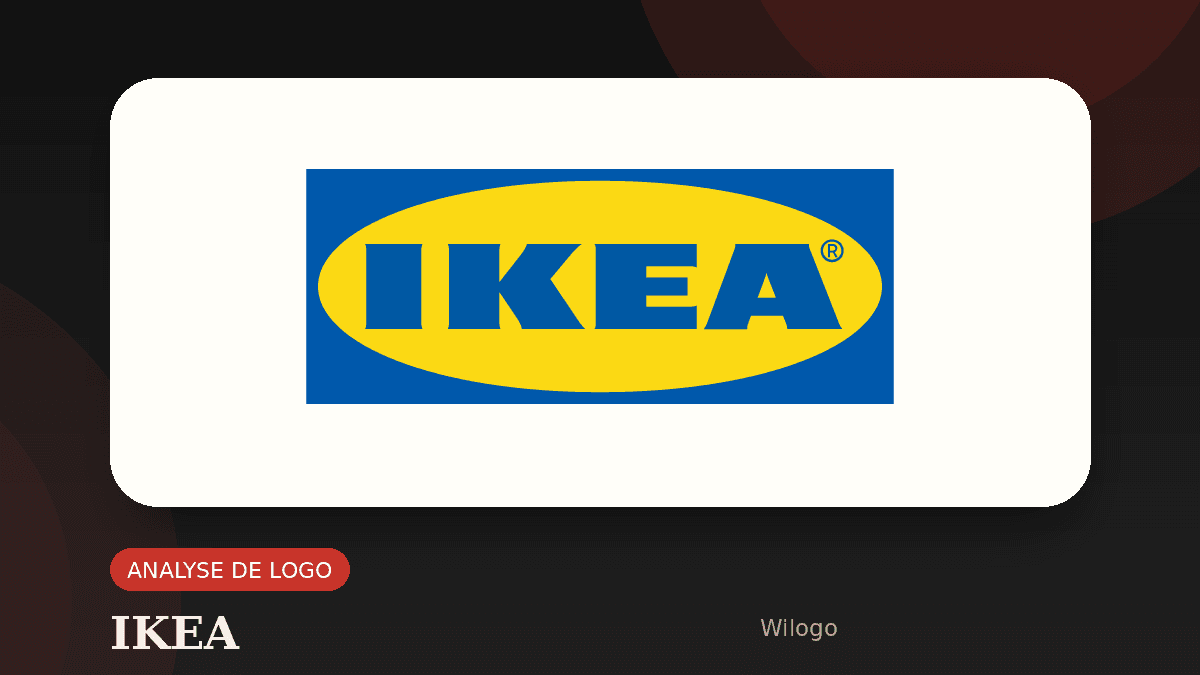
Real IKEA logo source
To avoid an invented or approximate visual, this article now uses the real logo artwork from the source below.

Source: Wikimedia Commons
IKEA logo: the history and evolution of blue and yellow
A practical look at a global identity, from early mail-order marks to a subtle digital refresh built for modern formats.
A simple name with very concrete roots
The IKEA logo is recognised before many people read the four letters carefully. A blue block, a warm yellow centre and a compact wordmark immediately suggest flat-pack furniture, accessible prices and pragmatic Scandinavian design. Yet this clarity did not exist from the beginning. The identity moved through decades of experiments, typographic variations, unexpected colours and very real constraints linked to catalogues, store fronts, packaging and mobile screens.
IKEA is not a decorative invented word. It combines Ingvar Kamprad, Elmtaryd, the farm where he grew up, and Agunnaryd, the nearby village in Småland. That origin matters because behind a global identity there is a very local anchor. The brand does not only talk about affordable furniture; it also keeps the trace of a founder, a place and a culture of practical economy.
For a small company, this is a strong first lesson. A good name does not need to be ornamental when it already carries a clear story. The visual system can then amplify that story instead of hiding it. A robust identity begins with a memorable reference that the public can connect to a promise.
The 1940s and 1950s: identity as experimentation
According to the IKEA Museum, Ingvar Kamprad registered the company in 1943. The first marks were primarily functional. They identified a business and built trust on documents, invoices, correspondence and mail-order material. The company first sold various goods, then added furniture to the range in 1948.
The logo followed that transformation with addresses, business descriptions, letter-case variations, accents, italic styles and extra words around the name. Nothing was fixed yet. This period is far from the blue and yellow icon we know today, but it is essential because it shows that visual identity often begins in real use, not in a perfect first version.
When an activity changes, the logo must clarify what the company is becoming. Early IKEA marks were not designed as museum posters. They answered a simple question: how can a mail-order seller appear identifiable and trustworthy? The same question still matters for a craft business, a consultant, a local service or an e-commerce brand.
From administrative mark to global signage
From the 1950s and 1960s, IKEA moved toward a more stable expression. Capital letters became more important, the composition became more compact, and the need for a sign that worked on catalogues as well as store fronts became central. The logo was no longer only an administrative signature; it became an orientation tool.
This distinction matters. A logo can look elegant on a business card and still fail on a sign, a bag, a website header or a navigation icon. IKEA gradually built a very robust visual architecture: a short name, strong contrast, a memorable silhouette and few details. That is why the sign can travel across so many supports without needing an explanation.
Consistency does not mean immobility. It gives change a frame. A brand can adjust a letter, a proportion or a colour without losing its audience when the core remains stable. This is also the idea behind responsive logo design: recognisability has to survive changes in size and context.
Blue and yellow: Swedish reference and memory code
Blue and yellow naturally evoke Sweden, but their branding strength goes beyond that national reference. Blue suggests stability, clarity and trust; yellow brings warmth, visibility and commercial energy. Together they create a high-contrast combination that works in a car park, a catalogue, an app or an advertisement.
The pair is also unusual enough in home furnishing to become a mental shortcut. When people see those two colours attached to simple shapes, they quickly think of IKEA. For a brand, colour is not only decoration. It builds memory, accelerates recognition and creates a consistent atmosphere across thousands of touchpoints.
That is why colour choices should balance trend and durability. A fashionable palette may attract attention for a season; a mastered palette can install a brand for years. The decision should include category codes, competitors, accessibility, print behaviour and the ability to stay consistent.
2018-2019: almost unchanged, but better adapted
The recent IKEA refresh is a case study precisely because it is almost invisible. Specialist coverage of Seventy Agency’s work describes enlarged lettering, adjusted spacing, refined typographic details and a more coherent handling of the trademark symbol. The aim was not to reinvent the brand, but to improve legibility and presence in physical and digital formats.
This kind of redesign requires discipline. Change enough to solve concrete problems, but not enough to break recognition. Many companies confuse modernisation with rupture. IKEA shows the opposite: when brand equity is huge, the best decision may be a series of micro-adjustments that mainly designers notice.
Digital constraints are central. A logo must remain legible in an app, a search preview, a social ad, a compressed image or a small navigation bar. The identity no longer lives on one primary support. It moves constantly between formats, and the strongest marks are those that keep their core in each one.
Visual analysis: why the sign stays memorable
The IKEA logo works because it combines three reading levels. From far away, people perceive a strong colour mass. At medium distance, they notice the frame, the central shape and the rhythm of the letters. Up close, they read the name. This hierarchy is very important because a logo should not depend only on perfect reading conditions. It also needs a silhouette.
That is what allows IKEA to exist in saturated environments, from motorway edges to mobile search results. The brand also shows that a popular logo does not have to be neutral. The colours are strong, the block is direct and the typography accepts its commercial role. For an entrepreneur, this is an invitation to choose clarity over invisible refinement.
Simplicity is not the absence of work. It is often the result of difficult decisions: remove weak details, strengthen contrast, test small sizes, check print behaviour and maintain discipline over time. A badly designed simple logo becomes generic; a well-built simple logo becomes a reference.
What entrepreneurs can learn from IKEA
The first lesson is coherence. IKEA did not keep exactly the same identity because change was forbidden; it evolved several times. But every evolution reinforced a use: being seen, read and remembered. The second lesson is operational simplicity. Four strong letters, two distinctive colours and a stable structure can live on thousands of supports without explanation.
The third lesson is time. The strongest identities are not necessarily those that change fastest. They accept fine adjustments, responsive versions and technical adaptations while keeping a constant core. If you are creating a brand today, think less about the “perfect” logo and more about the system that will still be understandable in five years.
The fourth lesson is to prepare constraints before creation. Your logo may need to appear on Instagram, an invoice PDF, a store sign, a vehicle, embroidery or a favicon. Also check the monochrome logo version. A durable identity is an identity that works when conditions are not ideal.
Turn inspiration into your own identity
Studying IKEA does not mean copying its colours, shapes or typography. The point is to understand the method. What should your audience remember? Which size, contrast and support constraints must your logo respect? Which part of your story deserves to become visible?
To turn those questions into a clear brief, you can prepare your project with Wilogo: create your logo brief. The goal is not to imitate a large brand, but to find a simple, honest and usable mark for your own business.
A practical checklist before designing your logo
Before you brief a designer or an AI-assisted creative tool, write down the three words people should associate with your brand, the smallest size where the logo must remain readable, and the most common background colours it will meet. Then test the idea in a square avatar, a horizontal header and a simple black version. This exercise often reveals problems early: letters that are too thin, colours that collapse in contrast, or a symbol that only works when it is large. The IKEA case is useful because it reminds us that the best identity is not the one that wins a moodboard, but the one that keeps performing in everyday contact with customers.
FAQ — IKEA logo
What does IKEA mean?
IKEA combines Ingvar Kamprad, Elmtaryd and Agunnaryd: the founder, the family farm and the nearby village.
Was the IKEA logo always blue and yellow?
No. Early versions were much more experimental, with different compositions, descriptors and colours before the current expression became standard.
Why was the latest redesign so subtle?
Because the goal was to improve legibility and multi-format consistency without destroying decades of recognition.
What should a small business remember?
A good logo should be readable, memorable, rooted in the brand story and robust across digital and physical supports.
Sources and context
This analysis is based on public material from the IKEA Museum, the IKEA Global history page, and specialist coverage by Dezeen and Seventy Agency about the subtle digital refresh. It is an editorial synthesis, not an official reproduction of the trademark.