Pepsi logo: 125 years of constant rebranding
From the Pepsi-Cola script to the 2023 globe comeback: history, strategy and branding lessons behind the Pepsi logo.
The Pepsi logo is one of the clearest examples of constant rebranding in consumer culture. Some brands protect the same symbol for decades. Pepsi has often done the opposite: a pharmaceutical-looking script at the end of the nineteenth century, a red white and blue bottle-cap idea in the 1940s, a modernist globe, separated wordmarks, dimensional spheres, an asymmetrical smile, and then a bold return to a more centered globe in 2023. This is not just a chain of graphic fashions. It tells the story of a brand built around motion, generations and pop culture.
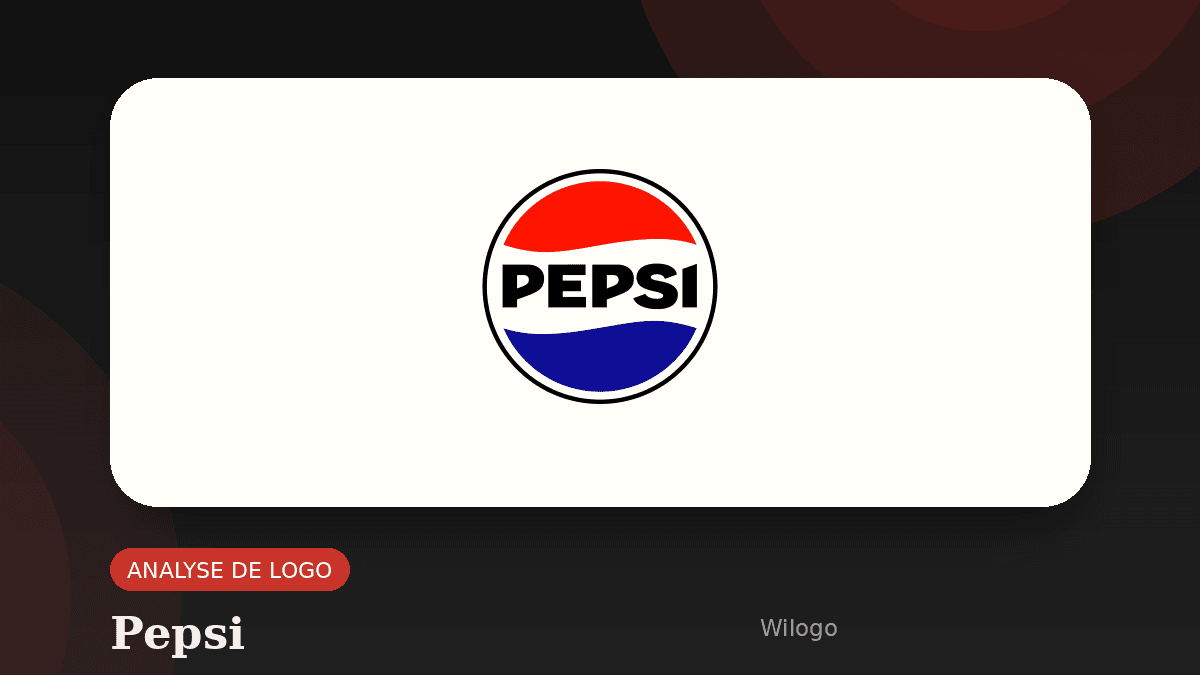
Real Pepsi logo source
To avoid an invented or approximate visual, this article now uses the real logo artwork from the source below.

Source: Wikimedia Commons
The story begins in New Bern, North Carolina. The drink appeared as Brad’s Drink in 1893, then became Pepsi-Cola in 1898. Its first visual territory was typical of the era: a red scripted wordmark, close to pharmacy and soda-fountain codes. Over time, Pepsi had to stand out on shelves, compete with Coca-Cola in the public imagination, speak to younger audiences and adapt to more and more media. The logo therefore became a laboratory. Each era left a mark: patriotism, modernism, minimalism, digital depth and nostalgia.
The identity unveiled by PepsiCo in March 2023 is especially interesting because it does not erase the past. According to PepsiCo’s official release, the system reunites the wordmark with the globe, introduces electric blue, uses black to support Pepsi Zero Sugar and adds a visual “pulse.” The rollout began in North America in fall 2023 for the brand’s 125th anniversary, followed by a global rollout in 2024. Pepsi used an anniversary not to freeze its history, but to reconnect heritage with contemporary energy.
Origins: a wordmark before the globe
Before it was a recognizable circle, Pepsi was a written name. The versions from 1898 and the early twentieth century followed the logic of many carbonated drinks: ornamental red lettering that suggested a recipe, a counter, a refreshment promise. At that stage, the logo was not yet a global system. It was a signature printed on simple supports in a market where packaging and local display mattered enormously.
This beginning matters because it reveals a constant. Pepsi has never sold only a beverage; it has sold an attitude toward consumption. Even when the mark looked like other soda scripts, the brand needed rhythm, memorability and easy display. For a company creating its identity today, the lesson is encouraging: a strong logo does not always start as a perfect icon. It can begin as a functional sign, then become sharper as the positioning becomes clearer.
125 years of redesigns: the main stages
In the 1940s, Pepsi adopted the code that would structure its visual memory: red, white and blue. The American context mattered, but the decision went beyond patriotism. These colors gave the packaging contrast and immediate shelf presence. The bottle cap became a circular motif, preparing the way for the globe. That shift is essential: the brand moved from lettering to shape. A shape is recognized faster, especially from a distance, on a vending machine, a cap, a truck or an ad.
The 1960s brought another turning point: Pepsi-Cola became simply Pepsi in brand use. Dropping “Cola” matched a faster tone and a desire to speak to a generation that wanted to feel different. The “Pepsi Generation” campaigns gave the logo a cultural role. It no longer signaled only a drink; it suggested youth, rhythm and a friendly challenge to the historical leader. Design became a competitive story.
From the 1970s onward, the globe became simpler and more central. The 1973 version expressed modernist confidence: clear geometry, flat colors and balance. Later decades brought many adjustments. The word could leave the circle, the sphere could gain volume, shadows could appear, blue could dominate. The 1990s and 2000s especially show the influence of screens and dimensional effects: Pepsi wanted to feel dynamic, technological and almost liquid.
The 2008 redesign remains one of the most debated. The globe became a softer, asymmetrical smile. It matched the period well: movement, simplified curves and a mark that could live in animation. But it also separated the Pepsi name from the center of the symbol. Many people recognized the globe, but the link between word, shape and product felt less direct. The 2023 redesign can be read as a response to that tension.
The 2023 logo: nostalgic, but built for digital use
The current Pepsi logo has an obvious strength: it feels like a comeback without being a pure retro copy. The wordmark returns inside the circle. Black frames and strengthens the composition. Blue becomes more electric. The shapes feel sharper. This gives the brand a stronger presence on cans, screens, trucks, social videos and events. Multi-touchpoint coherence matters because a mass-market logo must work on a shelf, as a small icon and in a few seconds of motion.
The black palette is strategic too. It adds contrast, but it also supports Pepsi Zero Sugar. As zero-sugar products become more important, the identity has to serve the whole range. PepsiCo explicitly connected the new palette and pulse with that direction. The logo is not merely decorative; it answers a brand architecture and a product priority.
Why does Pepsi change so often?
Pepsi changes often because its territory is cultural currency. The brand has long leaned on music, celebrities, events, youth and the codes of the moment. In that context, keeping exactly the same logo for fifty years could have felt distant. Rebranding becomes a way to say: we are still in the present. That is risky, because too much change can dilute memory. Pepsi limits the risk by keeping anchors: the name, the circular energy, red white and blue, and the implicit cola rivalry.
A comparison with other famous identities makes this clear. The BMW logo has evolved while keeping an almost stable structure. The Louis Vuitton logo protects its monogram as a heritage asset. Pepsi accepts more updates. No approach is automatically better. A luxury house often sells continuity. A pop beverage can sell the energy of change.
There is also a practical reason for this rhythm of change: Pepsi is a packaging-first brand. A logo on a beverage can is not seen like a logo on a business card. It competes with colors, flavors, limited editions, refrigerators, promotions and social campaigns. Small differences in contrast or hierarchy can have a large effect on visibility. That is why the 2023 system feels more assertive: the word is easier to read, the circle is more compact, and the black outline gives the mark a stronger edge in busy environments.
For smaller brands, the lesson is not to imitate Pepsi’s frequency. Very few companies have the budget to retrain recognition every few years. The useful lesson is to understand which parts of the identity are strategic and which are seasonal. A color palette, a symbol, a tone of voice or a layout principle can remain stable while campaigns, illustrations and secondary graphics evolve. Good identity systems make room for freshness without forcing a full redesign every time the market changes.
Lessons for creating or redesigning your own logo
The first lesson is not to confuse change with rupture. Pepsi changes a lot, but it does not restart from zero. Colors, globe and name act as memory anchors. For a small business, association or startup, this is valuable: before redesigning, identify what customers already recognize. Removing every reference may look newer, but it can also make the identity less memorable.
The second lesson is context. The 2023 logo was designed for packaging, digital touchpoints, fleets, retail and motion. A modern logo must be tested in real use: favicon, social avatar, sign, invoice, T-shirt, video, dark background, light background. If you hesitate between concepts, do not judge only the isolated file. Compare actual use cases. That is why a clear brief and guided iterations matter.
Finally, Pepsi reminds us that a logo needs a simple story. Even as an abstract globe, it suggests refreshment, motion, pop culture and a long market rivalry. Your brand does not need a global story, but it needs a direction. Before asking for a logo, define what the mark should communicate: trust, warmth, boldness, precision, craft, technology, elegance? To turn that intention into concrete routes, you can prepare a brief on Wilogo and compare several visual directions without losing the thread.
You can also browse more famous logo stories to see how very different marks become memorable when form, era and strategy work together.
FAQ
Why did Pepsi change its logo in 2023?
Pepsi wanted to reunite the wordmark and globe, strengthen contrast with black, support Pepsi Zero Sugar and create an identity that works across packaging, digital media and motion.
What is the most recognizable element of the Pepsi logo?
The red, white and blue globe remains the central memory cue. Typography and effects change, but the circular structure keeps recognition alive.
Does Pepsi change its logo too often?
It depends on strategy. For Pepsi, change supports a pop, generational image. The risk is dilution, but the brand keeps key anchors: name, colors and globe.
What can a business learn from Pepsi?
Keep useful memory cues, test the logo in real contexts and connect the redesign to a clear story. A good redesign modernizes without erasing recognition.