Twitter to X: analysis of a controversial rebrand
Twitter became X in 2023. Here is what the controversial rebrand reveals about brand equity, user habits and radical redesign.
Rebranding news
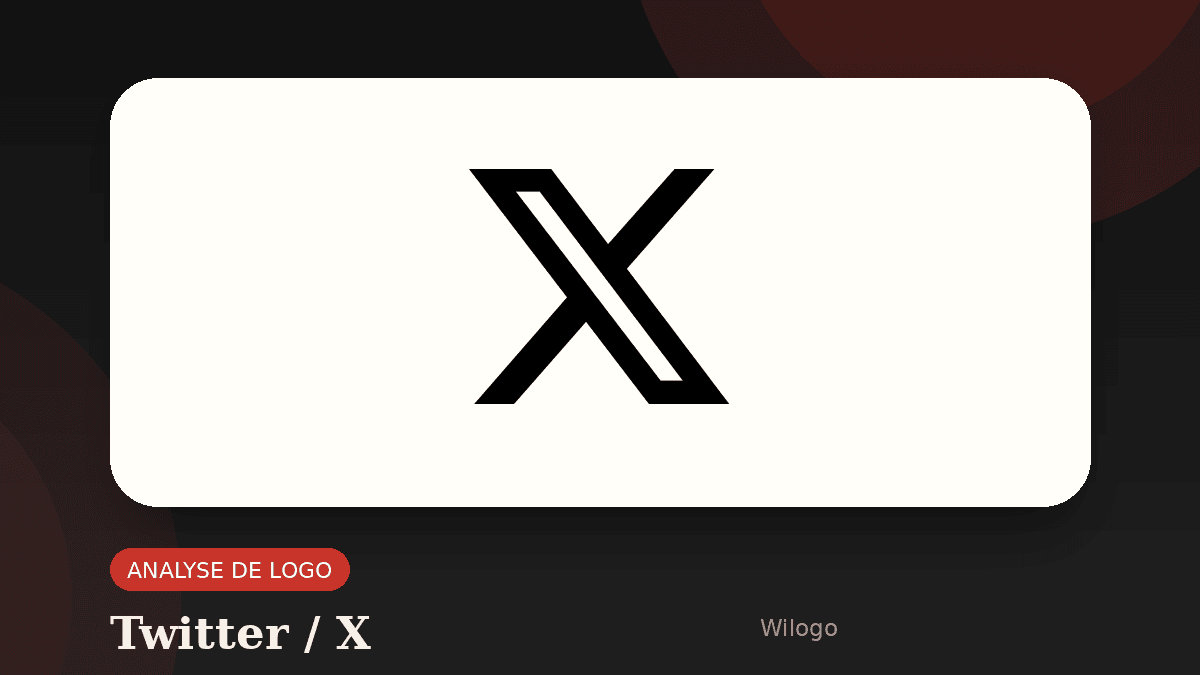
Real Twitter / X logo source
To avoid an invented or approximate visual, this article now uses the real logo artwork from the source below.

Source: Wikimedia Commons
Twitter to X: analysis of a controversial rebrand
In July 2023, Twitter retired the blue bird, its name and much of its shared vocabulary to become X. Few identity changes have shown so clearly the gap between strategic ambition and the emotional memory of a brand.

Why Twitter became X
On July 23 and 24, 2023, the change became visible: the Twitter name started to give way to X, the blue bird was replaced by a black-and-white mark, and x.com was presented as the new entry point for the platform. Reports from CNBC, TechCrunch and ABC News described a fast-moving rollout, announced by Elon Musk over a weekend and then reflected across the website, official accounts and apps.
The move did not come from nowhere. Since acquiring Twitter in 2022, Musk had repeatedly described his goal of turning the network into an everything app: a service that could combine conversation, video, messaging, payments, commerce and artificial intelligence. Then-CEO Linda Yaccarino framed X as a future of broad interactivity built around audio, video, messaging and financial services.
From a boardroom perspective, the reasoning is understandable. If the desired product is no longer only a short-message feed, the word Twitter can feel narrow. The bird vocabulary of tweets and retweets described a precise behavior: quick public messages moving through a network. X aims to be a wider umbrella, abstract enough to cover many functions.
The hard part is that product strategy does not erase user culture. Twitter was a name, but also a verb, a media habit and a social landmark. Changing that kind of brand means moving a collective habit. A radical rebrand therefore needs more than a destination; it needs a bridge between what people know and what the company wants them to imagine.
The brand equity at stake
The controversy starts with a basic branding fact: Twitter had rare brand equity. Very few companies enter everyday language. People did not merely say that they posted on Twitter; they tweeted. Newsrooms quoted tweets, public officials published threads, and brands built campaigns around a vocabulary that had become instantly understood.
By removing that system, X accepted the destruction of symbolic assets. The Branding Journal noted at the time that experts estimated the potential brand-value loss in the billions of dollars. The precise number is debatable, but the principle is not: a rebrand costs more than design work. It can also cost years of awareness, associations and learned behavior.
The blue bird worked because it translated the product. It suggested lightness, fast broadcast and public conversation. It also gave a warmer identity to a platform that could be tense and argumentative. Moving to X changes the emotional contract: black, minimal, harder, more mysterious. That is not automatically wrong, but it is a very different promise.
This is why the case matters for any logo redesign. A brand may need to change because its product, market or ambition has changed. But if it does not map what customers already value, it can confuse modernization with erasure.
What the new identity communicates
The X mark is deliberately abstract. It does not depict a community, an activity or an object tied to the product. That abstraction fits the platform ambition: X can suggest the unknown, a variable, a crossing point, a future experience. But abstraction requires more explanation than a narrative symbol such as a bird.
The speed of execution also shaped perception. TechCrunch noted that Musk called the logo interim. For users and advertisers, that word can be dangerous: a global brand cannot appear to change identity like a profile picture experiment. Even when experimentation is intentional, audiences expect stability from the signs that structure trust.
The color shift strengthened the rupture. Twitter blue helped the brand remain recognizable in screenshots, embeds and public conversation. Black and white can feel more premium, but also colder. On a platform already facing debates over moderation, brand safety and advertising, that coldness could be read as part of a broader hardening.
Design never lives alone; it lives in use. Wilogo's guide to logos and social media explains that a digital identity must work as a favicon, a mobile icon, a screenshot, a spoken name, a shared link and a crisis signal. X gains simplicity, but loses much of Twitter's semantic richness.
Why the reaction was so intense
The BBC captured the feeling of many users: the shift felt shocking because it touched a daily ritual. People were not only opening an app; they were entering a place with codes, jokes, words and memories. When those codes disappear quickly, the reaction is not purely rational. It becomes emotional.
Context made the change harder. The rebrand followed months of rapid product and policy moves: paid verification, algorithmic changes, view limits, moderation debates and advertising uncertainty. In an already unstable environment, a new identity may not look like a clear vision. It can look like one more disruption. Design then absorbs frustration created by the product.
The third reason concerns brands and media teams. Many organizations had years of Twitter references in share buttons, social guidelines, legal pages, campaign kits, automations and reports. Moving to X meant rewriting copy, clarifying terminology and explaining that X was the former Twitter. Journalistic usage kept the phrase formerly Twitter for a long time because the new name needed context.
The comparison with Jaguar's 2024 rebrand is useful: both brands chose cultural rupture rather than gentle evolution. The difference is that Twitter was also a global social infrastructure. Any ambiguity instantly became a meme, a critique or a public argument.
Failure, bet or unfinished transition?
It would be too easy to call the rebrand a failure only because it was mocked. A brand that wants to change category may accept a rejection phase, especially when it wants a different audience or business model. If X truly becomes a platform combining content, creators, payments, AI and services, the Twitter name might eventually have felt too narrow.
The real issue is the gap between promise and visible experience. At the moment of the change, many users saw mostly Twitter with a new name, not yet a super app. When product proof is not tangible enough, a rebrand can feel like a proclamation. A radical identity works better when it accompanies a transformation people can already feel.
The timing therefore created a strategic tension: should the company rename early to force the organization toward X, or wait until the new features are strong enough to justify the new name? The first option creates attention and an internal signal. The second protects existing equity. X chose maximum attention, with matching risk.
Years later, the old name still appears in conversation. Many people understand X but add formerly Twitter to remove ambiguity. That shows a key truth: interfaces can change overnight, but social language changes slowly.
Lessons for smaller brands
First lesson: do not rebrand only to look modern. A good redesign starts with a clear diagnosis: a new positioning, a new audience, a new model, a readability problem or a mismatch between offer and image. Without diagnosis, change looks like visual impulse.
Second lesson: list what must remain recognizable. It can be a color, a tone, a promise, a shape, a service name or a way of speaking. The stronger the visual rupture, the clearer the continuity must be somewhere else. Customers need to understand what they still recognize.
Third lesson: prepare the rollout. A rebrand is not just a logo file. It requires variants, social uses, email signatures, web pages, printed assets, customer messages and answers to predictable questions. Launch coherence matters as much as the drawing.
Fourth lesson: test words as much as shapes. Twitter had powerful words. If you change a name or vocabulary, ask what customers will need to learn, forget or explain to others. The cognitive cost of a change is real.
Finally, keep one rule in mind: visual identity should support strategy, not force the company to defend itself constantly. If you are weighing evolution against rupture, start with a precise brief. On Wilogo, you can create a clear logo brief to define goals, constraints, channels and the acceptable level of change.
Sources
FAQ
Why did Twitter change its name to X?
The change supports Elon Musk's ambition to move beyond microblogging toward a broader app combining conversation, video, messaging, payments and services.
Was the Twitter to X rebrand a failure?
It is better described as a high-risk bet. It damaged some of Twitter's emotional equity, but it could become coherent if the X experience proves a different product category.
Why did users criticize X so much?
Twitter had a deeply rooted logo, name and vocabulary. The change arrived quickly, during an unstable period, before the everything-app promise was clearly visible.
What should a company learn from this case?
Clarify the strategic reason, preserve recognizable cues, prepare the rollout and explain the continuity behind the change.