Meta, formerly Facebook: why change the name and logo?
Facebook became Meta to separate the parent company from the social app and signal a broader metaverse and technology ambition.
Rebranding news
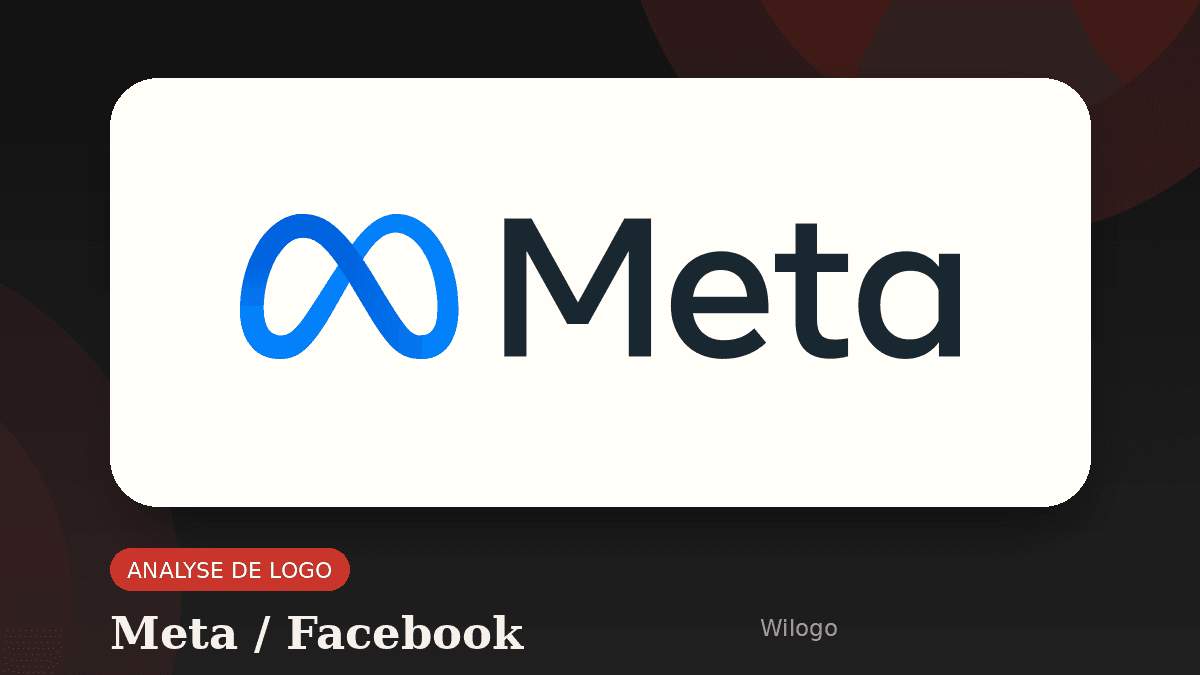
Real Meta / Facebook logo source
To avoid an invented or approximate visual, this article now uses the real logo artwork from the source below.

Source: Wikimedia Commons
Meta, formerly Facebook: why change the name and logo?
On October 28, 2021, Facebook Inc. became Meta. The Facebook app did not disappear, but the parent company adopted a new name, symbol and story to express a wider ambition: the metaverse, mixed reality and a family of products that had outgrown one social network.
Why Facebook became too narrow
At first glance, the move from Facebook to Meta can look like a surface-level rebrand: a shorter name, a blue loop symbol, a cinematic launch and a futuristic promise. The deeper reason was brand architecture. By 2021, “Facebook” meant the listed company, the original social network, a global advertising engine, Messenger, Instagram, WhatsApp, Oculus, augmented-reality research and a long-term vision for immersive computing. One name was carrying too many meanings.
In its official announcement, Meta said the new company brand would bring together its apps and technologies, with a focus on bringing the metaverse to life while helping people connect, find communities and grow businesses. The daily product reality did not change overnight. Facebook remained Facebook. Instagram remained Instagram. WhatsApp remained WhatsApp. What changed was the umbrella story above them.
Mark Zuckerberg put the issue clearly in his founder's letter: the Facebook brand was so tightly linked to one product that it could not represent everything the company was doing, or everything it wanted to build. For a brand strategist, that is a familiar problem at an extraordinary scale. A company often benefits from keeping the name of its first successful product. Over time, however, that same name can become a narrative constraint.
This is why the Meta case is different from a simple visual refresh. It was an attempt to separate the corporate identity from the flagship app. The comparison with Twitter becoming X is useful: X replaced the service brand directly, while Meta preserved the Facebook product and changed the parent brand above it. The level of risk is not the same.
What the name Meta is meant to do
The word “meta” comes from Greek and can be understood as “beyond”. In the founder's letter, the name is tied to the idea of a next chapter and to the belief that there is always more to build. It is short, international, easy to pronounce in many markets and abstract enough to include multiple businesses. It does not describe a social feed, a headset, a messaging app or a specific device. It creates strategic space.
That is exactly what a corporate name often needs when a company has moved beyond its origin product. Alphabet is not called Google Search Holding. Meta is not called Facebook and Other Apps. A good parent-company name must be broad enough to welcome future products, but concrete enough to feel intentional. In this case, the link with the metaverse was deliberate: the name announced the strategic thesis before the market had fully adopted the behavior.
The strength of that choice is also its weakness. When a name is attached to a large promise, the brand becomes exposed if the promise takes longer than expected to materialize. Since 2021, the technology conversation has shifted several times: virtual reality remains important to Meta through Quest and Reality Labs, but artificial intelligence, smart glasses and assistants have also become central to the public narrative. The word Meta remains flexible because it means “beyond” rather than one single virtual world, yet it still carries the memory of the initial metaverse bet.
For a smaller business, the lesson is not to pick a name because a trend is fashionable. Pick a territory that can survive changes in your offer. A good name does not have to explain the entire business. It has to give your market a credible, memorable and defendable direction.
What the new logo communicates
The Meta symbol is a continuous loop, close to both an infinity sign and a flexible “M”. Contemporary design coverage at the time highlighted that it was designed to exist in two dimensions, three dimensions and motion. That matters. If a company wants to talk about immersive worlds, virtual reality and spatial experiences, its logo cannot only behave like a mark printed on a business card.
The blue colour preserves continuity with the Facebook universe. That is a smart piece of brand memory: the name changes, the shape changes, but a familiar emotional cue remains. The loop suggests connection, flow and passage between spaces. It avoids the classic social-media vocabulary — the “f”, the speech bubble, the like gesture — and points toward a broader technology company.
The logo also illustrates a larger shift in identity design. Modern brands no longer need only a static emblem. They need systems that work in video, interfaces, investor decks, partner pages, app icons, physical events and sometimes mixed-reality environments. A brand identity becomes a grammar. Colour, movement, typography, spacing, usage rules and storytelling matter as much as the main silhouette.
There is a trade-off. Abstract symbols require repetition. Nobody naturally reads a blue loop as “global social and immersive technology ecosystem” without context. Meaning is built through consistent use over time. That is why a logo redesign should never be separated from a launch narrative, concrete examples and a clear explanation of what remains true.
The risks of such a public rebrand
The first risk was perceived avoidance. In 2021, Facebook was under heavy scrutiny around moderation, privacy, platform effects and public trust. Some observers therefore read the name change as an attempt to shift attention. That criticism does not erase the strategic logic of the rebrand, but it proves that a brand never launches in a vacuum. Timing can shape interpretation as much as design quality.
The second risk was the size of the promise. “Becoming a metaverse company” is a powerful statement, but it creates expectations. If products, use cases and adoption do not arrive quickly enough, the name can become a reminder of the gap between vision and reality. Large companies can absorb that gap with investment and time. Smaller companies should be more careful before promising a world they cannot yet deliver.
The third risk was fragmentation. Meta had to explain that Facebook, Instagram, WhatsApp, Messenger, Quest and future technologies belonged to one family without flattening their individual personalities. Too much unity can make products feel corporate and cold. Too much independence can make the parent brand invisible. The role of a corporate rebrand is to create a frame, not to erase every product's own identity.
The tension is similar to what happened with the Jaguar 2024 rebrand. When a famous brand changes its visual language, people judge what disappears as much as what appears. A new identity needs to create a bridge with existing memory, otherwise boldness can look like rupture for its own sake.
Lessons for brand owners
First, clarify the level of change. Are you renaming a product, a company, a range or an experience? Meta changed the parent-company brand, not the name of the Facebook social network. That architecture allowed the corporate story to move without immediately breaking user habits.
Second, define what the new name must carry. A name can signal ambition, reassure a market, simplify a portfolio or prepare international expansion. It cannot, by itself, fix trust, product quality or reputation. Before searching for syllables, write the role of the name in one sentence.
Third, keep a thread of continuity. Meta kept blue, simplicity and the idea of connection. Even a major visual break benefits from recognizable cues. Customers should not feel that the brand is denying its history. They should understand how the history is being translated.
Fourth, test the symbol in real contexts. A logo has to work as a favicon, social avatar, mobile header, video signature, sales document and printed item. For Meta, motion and 3D behavior were part of the concept. For many businesses, the priority will be readability on quotes, invoices, signage or LinkedIn profiles.
Finally, do not start with a visual trend. Start with a brief. Who are you trying to convince? What promise must be instantly legible? Which channels matter most? Which mistakes would damage trust? If you are preparing a new identity or a redesign, you can start with a clear Wilogo brief: create a logo brief in a few minutes.
Sources consulted
FAQ
Did Facebook disappear when it became Meta?
No. Facebook remains the social network. Meta is the parent-company name for Facebook, Instagram, WhatsApp, Messenger, Quest and other technologies.
Why does the Meta logo look like a loop?
The loop suggests the letter M, infinity, connection and movement. It was designed to work in 2D, 3D and motion-based contexts.
Was the Meta rebrand only a communication move?
It clearly had a communication dimension, but it also answered a real brand-architecture problem: the Facebook name was too closely tied to one product to represent the whole company.
What should a small business learn from Meta?
Clarify what is changing, preserve useful continuity and make sure the new identity is supported by product reality, not only by a launch announcement.