Renault logo: history and evolution of the diamond
From 1898 to the 2021 flat redesign, discover how Renault’s diamond became an automotive icon and what brands can learn from it.
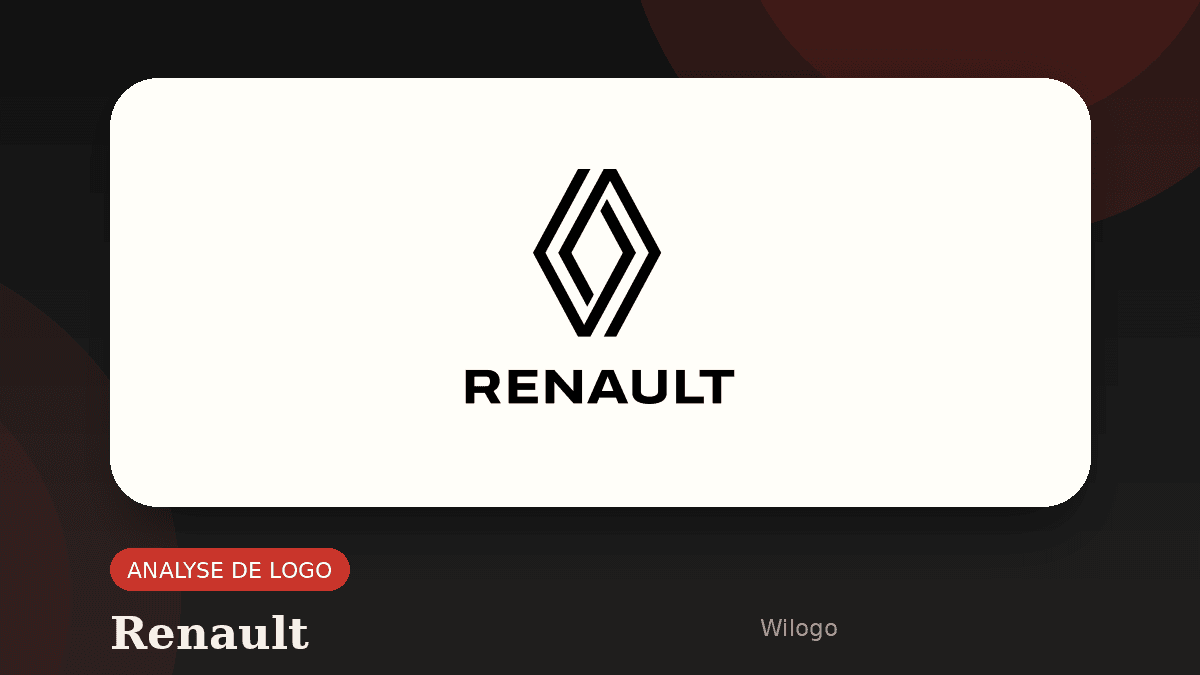
The Renault logo is one of those marks people recognize before reading a word. A diamond shape, a few lines, a metallic presence on a grille: that is often enough to evoke French automotive design, accessible innovation and more than a century of industrial history. Yet the current flat diamond is only the latest chapter in a long visual story.
Real Renault logo source
To avoid an invented or approximate visual, this article now uses the real logo artwork from the source below.

Source: Wikimedia Commons
From family initials to an automotive sign
Renault was founded in 1898 by Louis, Marcel and Fernand Renault. Like many industrial companies of that era, it first used a sign with a strong family feel: two intertwined R letters inside an Art Nouveau medallion. This early emblem mainly served documents, workshops and correspondence. On vehicles, recognition came from the Renault-Frères name, from racing success and from mechanical reputation.
This matters because, in the early days of motoring, a logo was not yet the central marketing asset it is now. Cars were rare, silhouettes were distinctive and buyers cared deeply about engineering. The graphic mark supported the company, but it did not yet carry the complete brand experience. That role would grow as streets became busier and carmakers competed for instant recognition.
By the 1920s, the front of the car had become a strategic surface. In 1923 Renault adopted a round frontal grille badge with the Renault name in the middle. It was both identity and hardware: the horn sat behind the grille, so the mark had to let sound pass through. Function came first, and the symbol followed the object.
Why the diamond took over in 1925
The decisive step came in 1925. The round mark gradually gave way to a more angular geometry that suited the two-plane bonnets and central crease of Renault vehicles. The diamond appeared on selected models before becoming the lasting signature of the brand. Renault Group still presents this shape as the foundation of the company's identity since 1925.
The diamond works because it is simple, distinctive and mechanically coherent. It is not a generic circle, and it is not an over-detailed coat of arms. It suggests direction, tension and balance. On a grille it reads from a distance; at small size it remains memorable; in relief it catches light. For a car manufacturer, that is a powerful combination.
The shape has never been frozen. Across decades, Renault changed line weight, volume, typography and material treatment while preserving the diamond as the core asset. This is also visible in other automotive identities, from the Mercedes-Benz star to Ferrari's horse and BMW's roundel. The best historic marks evolve without deleting their source of recognition.
The 1972 Vasarely turning point
In 1972 Renault introduced one of its most influential redesigns, developed with Victor Vasarely and his son Yvaral. The new diamond was built from parallel lines, creating an optical effect that felt both minimal and futuristic. The Renault name disappeared from the center, allowing the geometry alone to carry the brand.
This version was perfectly aligned with the period. Renault wanted a modern, industrial and accessible image, and the Renault 5 became the first model to wear the new symbol. The logo did not simply decorate the car; it matched a product that was compact, urban, popular and instantly identifiable. The sign and the vehicle reinforced each other.
The lesson is that a redesign can be bold without breaking the DNA. Vasarely did not replace the diamond with an animal, a letter or a complicated narrative symbol. He intensified the existing form. For an established brand, that is often the smartest route: protect recognition, then update the graphic language for a new cultural moment.
The 2021 flat-design comeback
After several three-dimensional versions in the 1990s, 2000s and 2010s, Renault revealed a new diamond in 2021 during the Renaulution plan and on the Renault 5 Prototype. Design director Gilles Vidal explained that the challenge was to keep one of the most recognizable shapes in the automotive world while making it simpler, more contemporary and better suited to digital use.
The 2021 emblem returns to a flat treatment. Two interlaced lines create a dynamic diamond with no wordmark and no unnecessary effects. This answers very current constraints: video animation, in-car screens, mobile interfaces, social media avatars and illuminated vehicle signatures. A modern logo must live in metal and in pixels.
Renault planned a progressive rollout across vehicles and brand touchpoints. That detail is important: a rebrand is not just an SVG file. It is an industrial and commercial operation involving cars, dealers, advertising, apps, documentation and online platforms. Consistency takes time, especially when the logo appears on physical products.
Lessons for your own logo
The first lesson from Renault is the power of a simple shape. If people can describe the sign in one word — here, diamond — it has a better chance of being remembered. That does not mean every company needs a pure geometric mark. It means the core idea of the logo should remain clear without a long explanation.
The second lesson is continuity. Renault updated its logo many times, but rarely denied its own history. A company with existing visual equity should ask what deserves to be kept before deciding what must change. The same principle appears in our analysis of the BMW logo: a durable symbol can survive many interpretations when the underlying idea remains stable.
The third lesson is adaptability. The 2021 diamond works because it was designed for grilles, screens, motion and brand environments. Today a logo must stay legible as a favicon, a social profile picture, a quote header, an invoice mark and a mobile UI element. This matters for a global carmaker, but it also matters for a small business or a startup.
Finally, Renault shows that a logo is never isolated. Perception depends on products, strategy, promise and cultural context. The diamond is strong because it carries over a century of innovation, popular models, industrial design and international presence. For a young company, the logo is a starting point; for a historic brand, it becomes compressed memory.
If you are building or refreshing an identity, Wilogo can help you turn your constraints into a clear creative brief and compare several directions without losing sight of practical use. Create a logo brief with Wilogo to define the formats, tone and recognition cues your future logo must handle.
For smaller brands, the comparison is useful because the same constraints appear at a different scale. A restaurant, a consultant or a software company may not place a badge on a car, but it still needs a mark that survives invoices, social profiles, presentation slides, packaging, signage and search results. The Renault story reminds us to test a logo in real situations before judging it only on a beautiful mockup.
That practical testing phase often reveals the real quality of a logo: not how impressive it looks once, but how reliably it works every day.
Key takeaways
- Renault has used the diamond as its identity foundation since 1925.
- The 1972 Vasarely version turned the emblem into a modern graphic icon.
- The 2021 version simplifies the mark for digital media, motion and recent vehicles.
- A strong historic logo evolves without erasing what makes it recognizable.
To explore more famous logo stories, read our article on the Ferrari logo, another automotive sign that became part of popular culture.
Sources and recent context
This analysis is based in part on Renault Group’s own pages about 120 years of brand identity and the 2021 launch of the new diamond. Those sources confirm the key dates: 1898 for the company, 1923 for the first frontal mark, 1925 for the adoption of the diamond, 1972 for the Vasarely version and 2021 for the current identity. They also show that a logo is not just decoration: it supports strategic plans, vehicle ranges and digital uses that keep changing.
Since 2021, the relevance of the line-based design has become even clearer. Carmakers need symbols that can move from a physical badge to an in-car interface, from a launch video to an app thumbnail. In that context, the Renault diamond reflects a broader branding trend: fewer effects, more legibility, and a strong desire to preserve the visual memory that reassures long-time customers.
FAQ
When did the Renault diamond appear?
The diamond became Renault's central symbol in 1925, after an early period of family initials and a round grille badge.
Who designed the 1972 Renault logo?
The 1972 version is associated with Victor Vasarely and his son Yvaral. Their parallel-line approach gave the diamond a striking optical quality.
Why did Renault change its logo in 2021?
Renault wanted a simpler, more digital and more animated sign while preserving the recognition of the historic diamond.
What can a small business learn from Renault?
A strong identity needs a memorable core form, consistent usage and controlled evolution rather than a pile of visual effects.