YouTube logo: history and evolution of the red play button
How the YouTube logo moved from a TV-style wordmark to a flexible red play icon built for a multi-screen world.
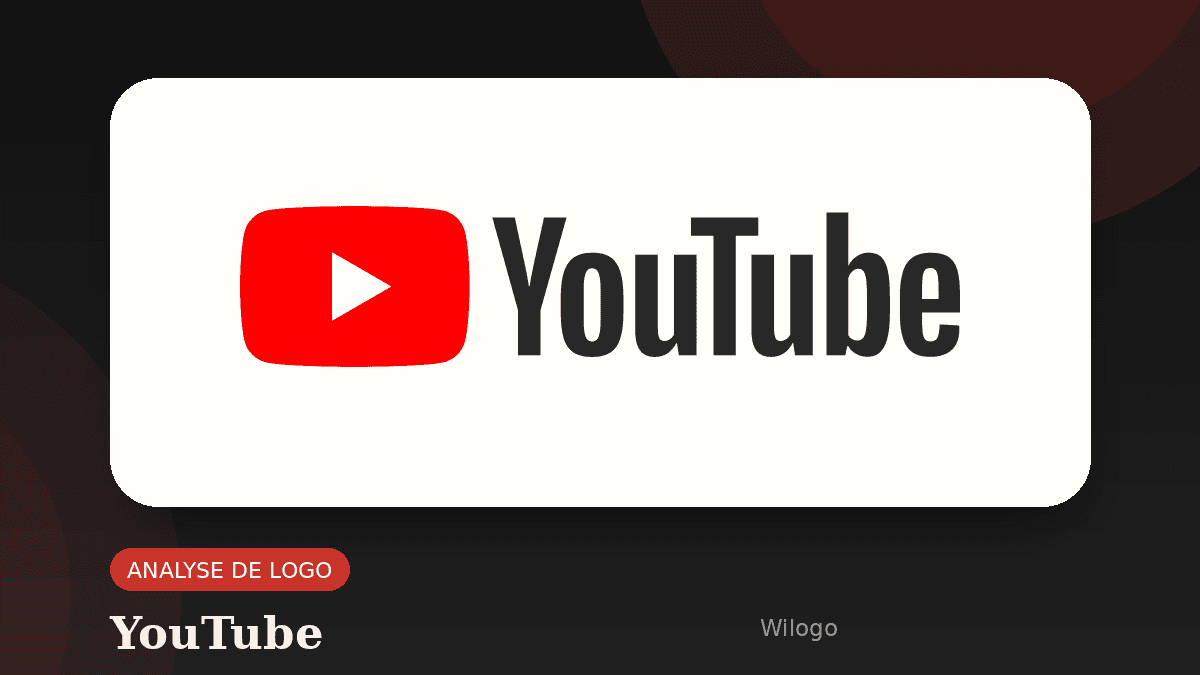
The YouTube logo is now one of the most recognizable signs on the internet: a red shape, a play idea, a black wordmark and an immediate promise. But this clarity did not exist from day one. In 2005, YouTube still looked like participatory television: the word “Tube” sat inside a glossy red capsule, almost like a small TV screen entering the browser. In 2017, the logic changed. The play symbol left the wordmark, moved to the front and became the flexible shortcut for the whole platform.
Real YouTube logo source
To avoid an invented or approximate visual, this article now uses the real logo artwork from the source below.

Source: Wikimedia Commons
Cover image: montage of the original 2005 YouTube logo and the 2024 YouTube logo, sources Wikimedia Commons 2005 and Wikimedia Commons 2024 (listed author: YouTube / Google, Inc.; logos may be protected as trademarks).
That evolution matters for any company designing a visual identity. The YouTube logo is not successful only because it is simple. It is successful because each simplification answers a real use case. The brand has to work on desktop, mobile, connected TV, thumbnails, app icons, notifications, dark interfaces, creator tools and product families. The design question is therefore practical: which element remains recognizable when everything else must disappear?
Recent sources confirm this system thinking. YouTube’s official 2017 blog post described a refreshed logo made for a multi-screen world, with an icon that could act as an abbreviated logo on small devices. In 2025, Google Design also explained why YouTube adjusted its red: the pure RGB red introduced in 2017 could feel too loud, render orange on some displays and create technical pressure on TVs. A nearly invisible color update can still be a serious brand decision.
1. 2005: a name that promised television by users
The first logo was built on a very direct word idea. “You” pointed to the user; “Tube” referred to television. At the time, YouTube’s promise was to make video easy to publish and share, while online video hosting was still heavy and fragmented. The red capsule around “Tube” made that idea visible. It was not yet a universal icon; it was a verbal little screen.
The design feels dated today, with its shine and volume, but it was effective in its original context. It explained the service quickly, introduced a strong color and split the name into two readable parts. A launch logo does not always need to be timeless. Sometimes it first has to make a new proposition understandable enough for people to adopt it.
2. 2011 to 2015: simplifying without breaking memory
The 2011, 2013 and 2015 versions did not reinvent the brand. They gradually removed overly glossy effects, refined the red and moved the mark closer to the flat language of digital design. This was the maturity phase: YouTube was no longer just an experimental website, but a global video platform embedded in everyday habits.
These small redesigns show an important rule: when recognition is strong, correction can be better than replacement. The red capsule stayed. The “You” plus “Tube” structure stayed. The compact typographic personality stayed. But fast-aging details — shadows, gradients and depth — were removed. The same pattern appears in many famous logo stories: the brand keeps the memory anchor and modernizes the execution.
For a small business, this is often the most useful lesson. A redesign does not have to erase the past. If customers already recognize a sign, removing it may be expensive. But clarifying proportions, cleaning a color, simplifying a secondary version or preparing a mobile mark can create a much more coherent identity.
3. 2017: the play button moves before the word
The 2017 redesign is the turning point. YouTube placed the play button to the left of the wordmark, instead of keeping the red shape around only the “Tube” part. The name became more unified, the symbol became autonomous, and the identity gained a short version that could work almost anywhere. It was a deep change, but not a rupture: the red color and screen idea remained.
The context explains the decision. By 2017, YouTube was no longer a single website. It lived inside apps, TVs, recommendations, notifications, YouTube Music, Kids, TV and Gaming. A full wordmark was not practical in every space. The platform needed an icon. The play button answered that constraint because it summarized the action: press, watch, continue.
This move resembles many successful redesigns: extract the strongest sign from an existing system, then give it independence. In our article on the BMW logo, the roundel works because it condenses history and format. In the Renault logo, the diamond survives because it can cross decades. For YouTube, that role belongs to the red play mark.
4. Red: visibility, energy and technical constraints
YouTube red is often described emotionally: energy, urgency, spectacle and the desire to click. That is true, but incomplete. A digital brand color must also perform. It has to remain legible in light and dark modes, on very different screens, inside interface components, tiny icons and animations. Red is not only decoration; it organizes attention.
The 2025 update makes this clear. Google Design explained that the team looked for a softer red, with accessible variations and a red-to-magenta gradient for selected moments of motion. The goal was not to replace the identity, but to improve perception and usability. It was an evolution, not a revolution.
Many companies underestimate this point. A color chosen on a desktop monitor can fail on mobile, in print, on a dark background or inside a tiny icon. Before approving a palette, test it in real contexts. A living logo is never an isolated image; it is a system of contrast, spacing, versions and decisions.
5. Type: turning a word joke into one brand name
The other important 2017 change concerns the wordmark. The two parts of the name are no longer treated as opposing blocks. The logo presents “YouTube” more clearly as one name. The type is cleaner, more screen-friendly and more stable at small sizes. It supports the symbol instead of competing with it.
This typographic restraint is strategic. If the red icon carries immediate recognition, the wordmark must confirm the brand without stealing attention. It needs to work in headers, announcements, app stores and official pages. The best brand typography is not always the loudest. Often, it is the one that lets the right sign breathe.
For a smaller brand, the lesson is simple: do not ask every part of your logo to say everything. A symbol can carry memory, typography can carry trust, and color can carry energy. Balance matters more than piling up ideas.
6. What to learn when creating or redesigning a logo
First lesson: identify the memory asset. YouTube did not abandon red; it clarified it. Second lesson: design for extreme use cases. If your logo works only large on a beautiful mockup, it is fragile. It also needs to survive as an avatar, favicon, signature, quote, social profile and printed asset.
Third lesson: separate the main logo from the icon. Since 2017, the button can work alone when space is limited. This is close to our guide on the responsive logo: a good system plans several detail levels instead of forcing one file everywhere. Fourth lesson: evolve colors carefully. An adjustment can be almost invisible to the public and decisive for usability.
Finally, the YouTube redesign reminds us that a logo is not a frozen artwork. It is a recognition contract with the audience. Changing it too strongly creates confusion; never changing it can make it age. The right rhythm preserves the cues that matter and removes what slows down legibility.
There is also a governance lesson. YouTube can update a color, a wordmark or an icon because the brand has rules for where each element appears. Small brands need the same discipline at a lighter scale: one main logo, one compact version, one monochrome version, defined colors, minimum sizes and examples of bad uses. Without these rules, even a good logo becomes inconsistent after a few months.
The practical test is simple. Place the logo in a website header, an invoice, a social avatar, a presentation cover, a dark background and a one-color stamp. If the sign still feels like the same brand, the system is strong. If each context needs an improvised fix, the identity is not finished yet. YouTube’s evolution is a reminder that durability comes from prepared variations, not from a single beautiful file.
Preparing a visual identity?
Describe your business, touchpoints and the signs your brand should keep or evolve. Wilogo helps turn that brief into clear, comparable logo directions built for real uses.
FAQ
Why is the YouTube logo red?
Red gives the mark instant visibility and energy. YouTube also needs a color that remains usable across screens, interface moments and accessibility constraints.
When did the play button become central?
The decisive change came in 2017, when the red shape moved out of the wordmark and became a standalone icon next to the name.
Did YouTube update the logo in 2025?
Yes. For its twentieth anniversary, YouTube introduced a softer red and a red-to-magenta gradient for selected brand and interface moments.
What can small brands learn from it?
Keep the recognizable asset, simplify what ages badly, and design a flexible system instead of a single static image.